Bucknell Research Uses Typing Patterns to Detect AI-assisted Academic Dishonesty
August 27, 2026
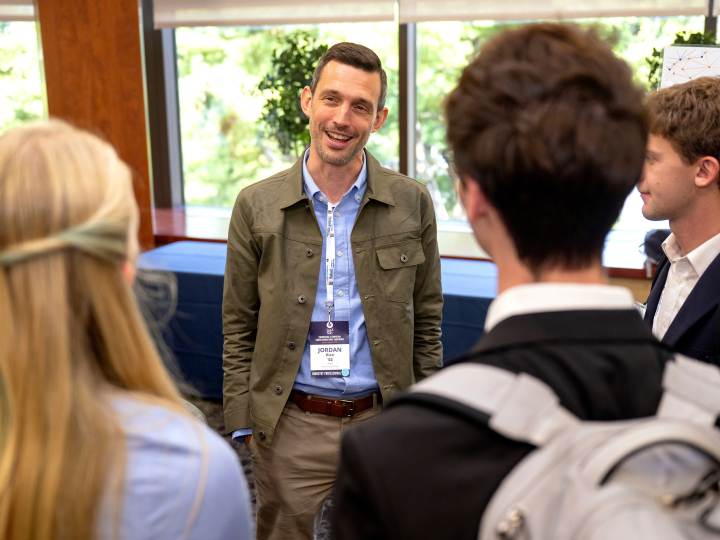
Professor Rajesh Kumar, computer science, and his student researchers are developing an approach that analyzes how students type to distinguish genuine writing from AI-assisted work. Photo by Emily Lamparter, Marketing & Communications
As generative artificial intelligence (AI) makes it increasingly difficult to determine whether students have produced their own academic work, Bucknell University Professor Rajesh Kumar, computer science, is looking beyond the words on the page for answers.
Kumar and his student researchers are developing an approach that analyzes how students type — including their typing behavior, including insertions, deletions, revisions and speed — to distinguish genuine writing from work produced with the assistance of large language models (LLMs) such as ChatGPT.
"Typing patterns, captured via keystroke dynamics — the timing between the keys — tell us a lot about how the text is produced," Kumar says. "Now we're not just analyzing the text, but how it’s produced."
Kumar was one of the authors of a related paper published last spring in IEEE Transactions on Biometrics, Behavior, and Identity Science, which demonstrates that keystroke dynamics can capture behavioral, cognitive and motor patterns that are difficult to replicate through copying, transcription or paraphrasing. The approach could provide universities with another tool for addressing academic integrity as generative AI becomes increasingly integrated into student work.
Traditional plagiarism detection has largely compared submitted text with existing sources, while newer AI detectors attempt to identify linguistic characteristics associated with machine-generated writing. Kumar's approach instead examines the process that created the text.
In controlled experiments, participants answered questions independently and then completed tasks with generative AI assistance, including paraphrasing AI-generated material. The latest study expanded his earlier best paper award-winning work by adding 90 participants and examining realistic attempts to disguise AI-assisted writing.
The results showed that analyzing how people type can be highly effective at identifying AI-assisted writing. Under controlled conditions, the study's machine-learning models correctly distinguished between genuine and AI-assisted writing with very high accuracy, while a neural-network model also performed strongly when participants tried to disguise AI-generated material by paraphrasing it. In several tests, methods that examined only the finished text — including existing text-based detectors, a large language model and human reviewers — did little better than guessing.
The researchers also tested whether users could deliberately fool the system by forging keystroke patterns. While some machine-learning models initially proved vulnerable, adversarial training substantially improved their resistance to those attacks.
"Behavioral patterns, especially keystroke (key up and keydown timings) are far, far harder to imitate," Kumar says.
Bucknell student researchers — Ashley Brandenburger '28, Minh Dau '28, Thanh Dong '28, An Ngo '26 and DongHyun Roh '27 — have examined whether Kumar's idea works across varying cognitive loads and deception techniques, and whether it extends to languages beyond English (Korean and Vietnamese). Kumar and his students are also beginning to investigate whether similar methods can identify AI-assisted computer programming.
The research has already influenced Kumar's teaching as he restricts copy-paste in his courses. But he cautions that keystroke-based detection isn't ready to serve as a stand-alone arbiter of academic misconduct. The study acknowledges limitations, including its controlled research setting, differences among keyboards and individual typing habits, and the potential for false positives. Collecting behavioral data also raises important privacy and consent questions.
"These ideas need to be tested in the wild [outside the controlled research setting]," Kumar says.
Kumar's research interest draws on behavioral biometrics, which identifies individuals through behaviors such as walking, typing or swiping on a device rather than physical characteristics such as fingerprints or facial features.
Future research will expand the diversity of participants, devices and writing environments while exploring additional behavioral signals such as mouse movements, typing acoustics and eye gaze. Kumar also sees potential applications beyond detecting misconduct, including using typing behavior to better understand how students learn and provide more constructive feedback.
"Slowly we realize students are going to use AI," Kumar says. "We just have to teach them how to use it."