Sing Chun Lee, Computer Science
September 23, 2026
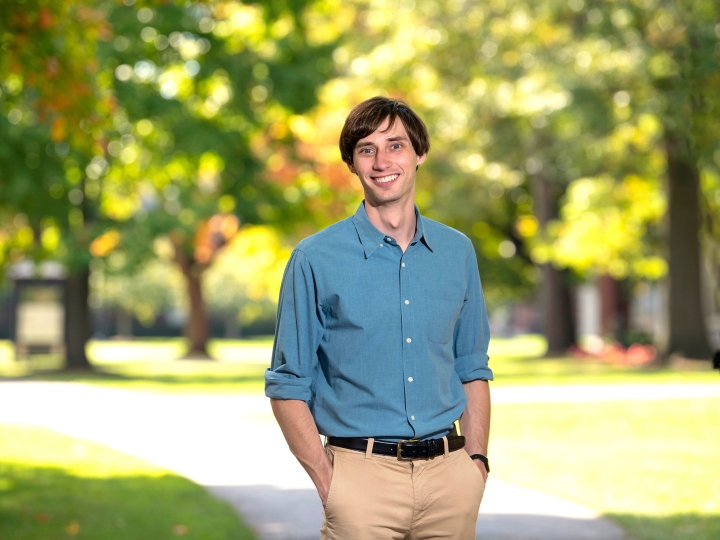
Professor Sing Chun Lee, computer science, explores how emerging technologies such as AI, augmented reality and virtual reality can enhance learning. Photo by Emily Lamparter, Marketing & Communications
When Professor Sing Chun Lee, computer science, arrived at Bucknell, he encountered an idea that had never really been part of his education before: the liberal arts.
For Lee — a computer scientist who studies how students learn in an age of immersive technologies — the experience reshaped how he thinks about education itself.
Technical expertise still matters. But he has a new appreciation for the broader habits of mind the liberal arts cultivate: curiosity, ethical reasoning and the ability to see problems from multiple perspectives.
A Path Shaped by Mathematics
Growing up in Hong Kong, college itself was never a guarantee. A first-generation student raised by a single mother, Lee grew up in a modest neighborhood where the expectation was to finish high school and go to work.
What changed his path was mathematics. Lee had excelled in mathematics, guided by inspiring teachers who made complex ideas feel like puzzles to be solved. His mentors' encouragement led him to pursue higher education in Hong Kong. There, students rank their preferred majors and are admitted based on exam performance. With strong math scores — and just enough English to pass — he was admitted to a relatively new program that combined mathematics and information engineering.
The program introduced him to a new way of thinking. Mathematics provided the theoretical foundation; computing and engineering translated those ideas into real-world solutions.
"That’s when my mindset started to change," he says. "It wasn't only about solving math problems anymore. It was about asking, 'How can this solve a real problem in the world?' "
That foundation launched a career that spanned industry and advanced research. From programming for semiconductor automation to managing government IT projects, he honed skills that would later underpin his work in biomedical computing and surgical innovation.
While in Germany for graduate studies, Lee discovered how computing could directly improve patient care, and he contributed to research on augmented reality to make orthopedic procedures safer and more precise. That was research he continued while obtaining his doctorate at Johns Hopkins University.
Reimagining Computer Science Education
Now at Bucknell, he brings that same sense of curiosity and practical problem-solving to the classroom and the lab. His research has since pivoted to computer science education. In collaboration with students and colleagues, Lee is exploring how emerging technologies can help students learn programming concepts more effectively.
A recent study co-authored with Colin Soule '25, who is now pursuing a doctorate at William & Mary University, was presented at the American Society for Engineering Education (ASEE) Annual Conference 2025 and published in its conference proceedings. A follow-up paper on the same topic was also accepted to the 12th International Conference of the Immersive Learning Research Network and will appear in its conference proceedings published by Springer.
His recent scholarship also includes two additional papers accepted for presentation at ASEE 2026: one with Nicole Qian '28 that uses game theory to optimize question bank size in a teach-for-mastery course setting, and another with Ayano Nozawa '27 that examines how students respond to different visualization platforms for learning programming concepts. Together, these projects reflect his broader commitment to improving computer science education.
By leveraging augmented and virtual reality, Lee investigates whether abstract computing ideas become more intuitive when students can see and interact with them in three-dimensional environments. More broadly, his work asks a timely question: How should computer science be taught in an era when artificial intelligence can generate code and information instantly?
Under his mentorship, Bucknell students are tackling projects that range from translating between international sign languages in virtual environments to creating more intuitive virtual keyboards — applications that blend technology, accessibility and creativity. Beyond technical innovation, he is passionate about shaping how students think.
"Computer science," he says, "is a way of solving problems — ethically, critically, and in ways that enhance society." In his teaching, he encourages students to ask questions, explore multiple perspectives, and approach AI and other tools responsibly — skills he considers essential in an era where information is ubiquitous but discernment is rare."
For him, Bucknell's liberal arts environment is the perfect setting to cultivate curiosity, creativity and thoughtful problem-solving in the next generation of innovators.