Bucknell, President John Bravman Host National Media, College Leaders at Annual Presidents Dinner
September 14, 2026
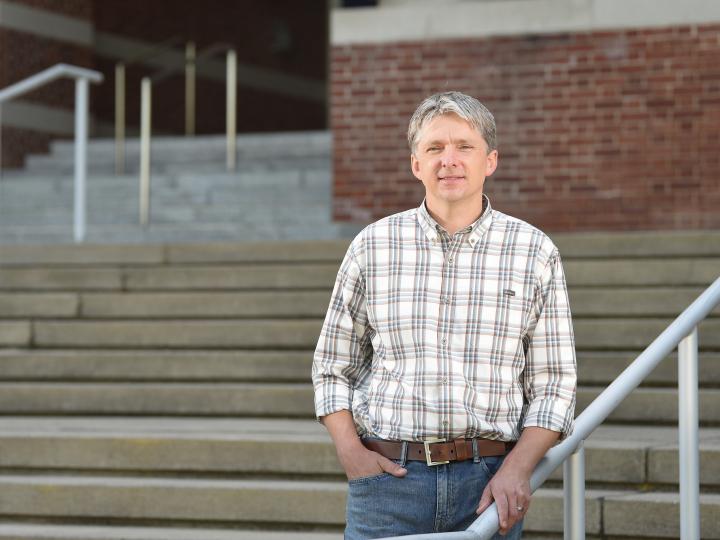
President John Bravman leads the dinner discussion on the state of higher education during The Presidents Dinner at Washington's famed National Press Club. Photo by Emily Lamparter, Marketing & Communications
For nearly two hours inside Washington, D.C.'s storied National Press Club, 12 presidents of private, highly selective colleges and universities confronted questions that are reshaping American higher education: What is a college education worth? How should campuses respond to artificial intelligence? And how can institutions preserve their missions while adapting to unprecedented financial, demographic and political pressures?
Those questions — and many more — drove a candid, on-the-record conversation Thursday, Sept. 10, at the ninth annual Presidents Dinner, hosted by Bucknell University and moderated by President John Bravman.
The presidents joined nearly 30 journalists representing 17 national news organizations, including ABC News, The Associated Press, Bloomberg News, The Boston Globe, The Christian Science Monitor, The Chronicle of Higher Education, Higher Ed Dive, Inside Higher Ed, The New York Times, NPR, Open Campus, POLITICO, Trusteeship Magazine, University Business, U.S. News & World Report, USA TODAY and The Wall Street Journal.
The annual gathering is designed to foster frank discussion between higher education leaders and the journalists who cover them about issues affecting colleges, their students and society at the start of a new academic year.
A Sector Facing Change
Joining Bravman were presidents Garry W. Jenkins of Bates College, Vincent D. Rougeau of the College of the Holy Cross, Manya Whitaker of Colorado College, Adam S. Weinberg of Denison University, Lori S. White of DePauw University, Andrew Rich of Franklin & Marshall College, Anne F. Harris of Grinnell College, Julie Kornfeld of Kenyon College, Sarah Willie-LeBreton of Smith College, Elizabeth H. Bradley of Vassar College and Maud S. Mandel of Williams College.
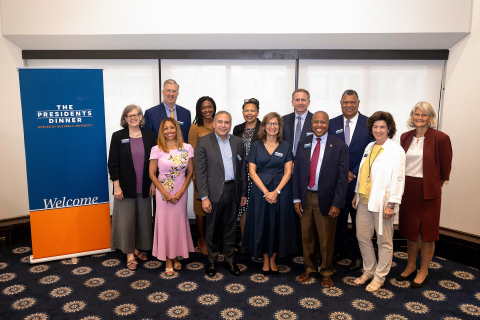
Participating presidents in the ninth annual Presidents Dinner. Front row, from left: Anne F. Harris, Grinnell College; Lori S. White, DePauw University; Adam S. Weinberg, Denison University; Julie Kornfeld, Kenyon College; Garry W. Jenkins, Bates College; Maud S. Mandel, Williams College. Back row, from left: John C. Bravman, Bucknell University; Manya Whitaker, Colorado College; Sarah Willie-LeBreton, Smith College; Andrew Rich, Franklin & Marshall College; Vincent D. Rougeau, the College of the Holy Cross; Elizabeth H. Bradley, Vassar College. Photo by Emily Lamparter, Marketing & Communications
Their wide-ranging discussion touched on affordability, financial aid, AI, career preparation, civic engagement, enrollment and demographic trends, institutional finances, international students, research funding, freedom of speech, admissions, student outcomes and the relationship between higher education and the federal government.
AI surfaced almost immediately, with presidents discussing both their personal use of the technology and its growing impact on teaching and learning. Weinberg said Denison is approaching AI from several directions — teaching students to use it effectively while also recognizing when it can undermine learning.
"How do we weave AI throughout the curriculum so every single one of our students graduates with some sort of AI fluency?" Weinberg said. "Where do we not use it? Because it stunts learning."
Jenkins offered an example from Bates, where a psychology professor uses AI-generated personas to allow students to interact with simulated patients exhibiting different mental illnesses — an educational experience that would otherwise be difficult to replicate with undergraduates. He said such experimentation demonstrates how AI can "advance education in ways that weren't even possible before."
The Value of a College Degree
Affordability and public perceptions of higher education emerged as another recurring theme. Whitaker argued that college should be viewed not simply as a transaction but as an investment whose benefits extend across a lifetime.
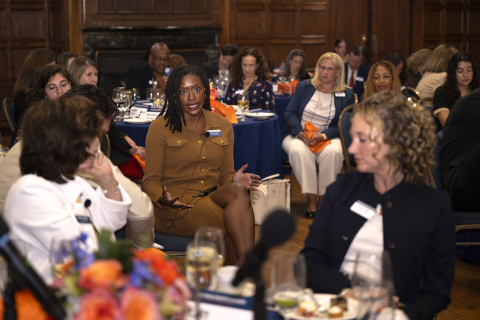
Colorado College President Manya Whitaker responds to a question during the dinner. Photo by Emily Lamparter, Marketing & Communications
"We know from decades of research [that] a college degree is something that yields returns across a lifetime," she said. "If I have to decide whether I invest in a house or I invest in myself, I choose myself every time."
The presidents also pushed back against measuring the value of college solely through graduates' earnings shortly after graduation. Rougeau cited Holy Cross graduates who enter the priesthood, volunteer programs and other service-oriented careers as examples of outcomes whose value cannot easily be measured by salary.
"What is the value of service? What is the value of self-gift to your community?" Rougeau asked. "You cannot monetize that."
Federal policy generated some of the evening's most extensive discussion, including financial aid, research support, tax-exempt status and international students. Jenkins noted that even smaller private colleges depend on federal programs such as Pell Grants and work-study while also being affected by federal policies governing international students.
"There's no possible way that any institution can just decide to opt out of what's happening, even if they had unlimited resources," he said.
The evening also turned to the question of whether traditional decision-making structures can keep pace with rapid change.
"The traditional shared governance model that we have used through generations has made change in higher ed very slow, and we cannot afford to be slow in this current environment," White said. "And so we've got to figure out a way to honor those shared governance principles to bring our community together and figure out ways to do that."
Bravman acknowledged that tension, saying Bucknell's own examination of shared governance has demonstrated both its value and the challenges of responding quickly as society changes.
The discussion offered no single prescription for navigating higher education's challenges. Instead, the Presidents Dinner provided something increasingly valuable in a rapidly shifting environment: an opportunity for college leaders and the journalists covering them to question assumptions, exchange perspectives and candidly explore where higher education goes next.