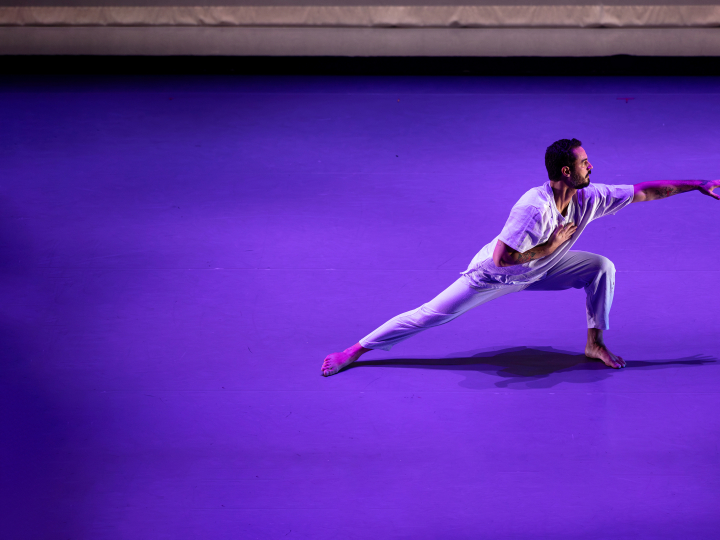
Bucknell Students Learn a New Approach to Theatre in India
September 24, 2026
Before six Bucknell students traveled halfway around the world for an immersive theatre experience in India, theatre professors Anjalee Deshpande Hutchinson and Mark "Hutch" Hutchinson made one thing clear: This would not be a vacation.
Over the course of 20 days in May and June 2026, the students traveled through Chennai, Puducherry and Mumbai. Ten of those days were spent in intensive training at the internationally renowned Adishakti Laboratory for Theatre Art and Research, where they worked alongside professional Bollywood actors and directors. The days were long, and the work was physically and emotionally demanding, immersing the students in a performance tradition unlike anything they had experienced in the United States.
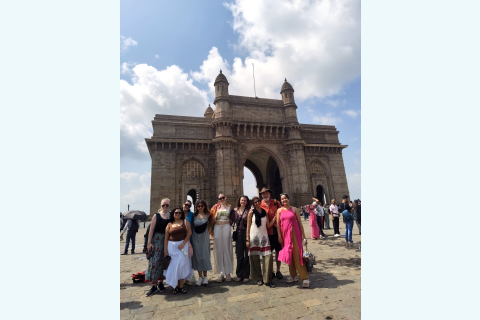
Bucknell theatre students and faculty visit the Gateway of India in Mumbai during an immersive exploration of theatre and culture. Photo courtesy of Anjalee Deshpande Hutchinson
Learning a New Approach to Theatre
At Adishakti, students followed an intensive daily schedule that began before breakfast with eye exercises and intense physical conditioning, then moved into breathwork, rhythm, movement and performance training rooted in classical Indian theatre traditions.
"We couldn't really see where they were going with all of the exercises until maybe the third or fourth day," says Claudia Stutzman '28, a theatre and linguistics double-major. "Then the connections started to become clearer. It was more that we had to come to the conclusions ourselves than have someone tell us exactly what we were supposed to take away."
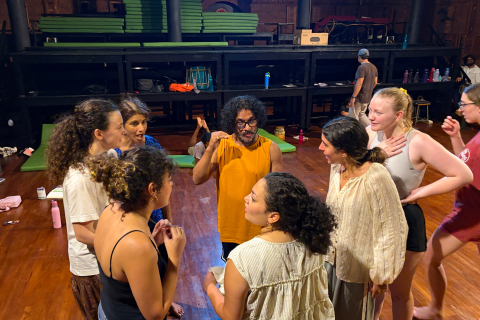
Bucknell theatre students trained with Bollywood actors and directors at the internationally renowned Adishakti Laboratory for Theatre Art and Research. Photo courtesy of Anjalee Deshpande Hutchinson
"In a lot of Western film and theatre performances, actors are trained in techniques to help them elicit, provoke and feel intense emotion and then share those emotions with an audience," Deshpande Hutchinson says. "At Adishakti, the approach begins with the breath. Every emotion has a breathing pattern — laughing, crying, anger, rage. By changing your breath and the physical structure of the body to achieve that breath, the emotion follows."
"I had never connected acting to my breath before," says Defne Gumus '27, a biology major and theatre minor. "It felt almost scientific. You change your breathing, and it changes the emotion. It was different from anything I'd learned before. I was able to cry on command."
Putting Lessons Into Practice
The journey culminated in Mumbai, where students devised and performed an original theatre piece for children and families with Embers International, an organization that supports survivors of human trafficking and their families. The performance gave them an opportunity to apply what they had learned. The trip was made possible through the generosity of Juliet Shields Taylor '83, whose support, along with funding from Mark Hutchinson through his 2025 Walter C. Geiger Award and Arts Council grants, reduced the student cost to less than $1,500, which included travel, housing, meals and program expenses.
The partnership with Embers was strengthened by Bucknell trustee Makoto Fujimura '83, P'13, a renowned artist who serves as the organization's Artist Advocate Counsel, and his wife, Haejin Shim Fujimura, co-founder and chief executive officer of Embers International.
The lessons won't stay in India. They'll shape the way students will rehearse, perform and collaborate at Bucknell — and beyond.
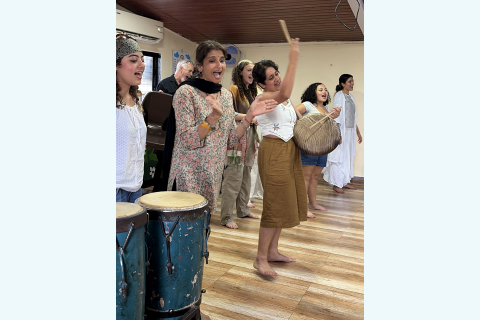
Bucknell theatre students performed an original theatre piece for children and families in Mumbai. Photo courtesy of Anjalee Deshpande Hutchinson
"I don't think I'll ever approach acting the same way again," Gumus says. "Now, whenever I'm building a character, breath is the first place I start."
Stutzman, who will be directing a show this fall, says the training changed how she thinks about creating theatre. Rather than beginning with dialogue or emotion, she'll now think first about movement and breath.
"I'm excited to have the opportunity to incorporate what I learned," she says. "I think I will carry the techniques we learned to express emotion into my future work, especially when I'm collaborating with other students who went on the trip."
The experience also reinforced Stutzman's interest in theatre and linguistics, particularly in phonetics. She sees a future in theatre, particularly in directing, stage management and dialect coaching.
"I feel like my mind has expanded," Gumus says. "I'm more open to new experiences because I said yes to every opportunity. Now I think, 'If I could go to India and do all of that, why not try this too.' "
For their professors, the lasting impact was the goal from the beginning. "The goal wasn't simply to teach students another acting method," Deshpande Hutchinson says. "It was to help them become more thoughtful artists, more curious learners and more compassionate citizens."