Bucknell Research Team Tackles Air Quality in Pennsylvania's Coal Region
November 5, 2026
Professor Dabrina Dutcher (center) speaks with Calvin McGuire '29 (kneeling) and Samuel Tuffour ’28 (right) about the installation of an air quality monitor on top of the Academic East building, while Professor Doug Collins and Shaunna Barnhart (behind) discuss it. Photo by Emily Lamparter, Marketing & Communications
When Mount Carmel Township declared a state of emergency last week due to smoke from a culm bank/mine fire in Locust Gap, that poor air quality condition is exactly why a Bucknell University research team is working to better understand the air quality of a region shaped by anthracite coal mining and environmental challenges.
Supported by a $250,000, two-year grant through the U.S. Environmental Protection Agency (EPA) Region 3 Thriving Communities Grantmaking program, the team is establishing an air quality monitoring network across Pennsylvania's lower anthracite Coal Region to investigate potential pollution risks and provide residents with information about the air they breathe.
Professors Doug Collins, chemistry; Dabrina Dutcher, chemical engineering and chemistry; and Brian King, computer science, faculty fellow for the Dominguez Center for Data Science (DCDS), have teamed up with Shaunna Barnhart, program director of the Place Studies Program in The Ecology Center to lead the project.
Sophisticated monitoring equipment has been installed at nine locations across Mount Carmel, Kulpmont and Shamokin, with additional sites planned.
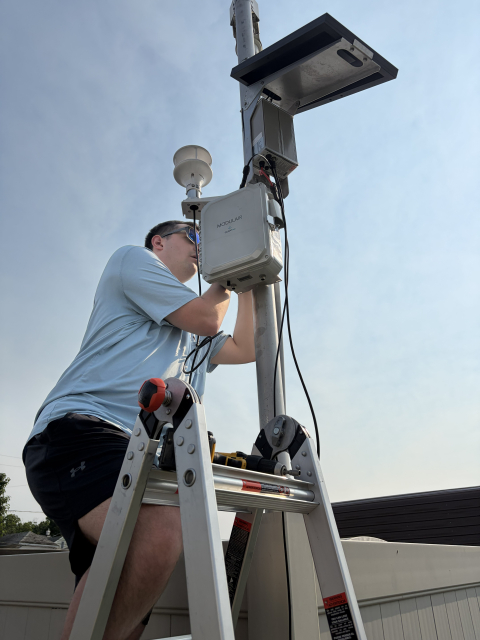
Calvin McGuire '29, chemistry, installs sophisticated air quality monitoring equipment in Kulpmont. Photo by Doug Collins
The instruments measure multiple air pollutants, helping researchers establish a baseline of environmental conditions in communities where comprehensive air quality data has been largely unavailable.
"There are no state or federal sensors in the lower anthracite Coal Region, and the nearest ones are over 30 miles away," Barnhart says. "Air quality can change dramatically over short distances, so having information from the communities themselves is really important."
Researchers are particularly interested in whether the region’s geography, coal mining legacy and other environmental factors contribute to pollution exposure, and possibly health consequences.
The region experiences health disparities involving asthma, cardiovascular disease and cancer, although researchers emphasize that any relationship between those conditions and local air quality remains unproven.
"We're trying to provide people with [air quality] information they can use for themselves," Collins says. "We want to help them understand what that information means and provide whatever support we can to improve their communities."
Community Participation Essential
The researchers are now recruiting approximately 20 residents throughout the Coal Region and surrounding communities to host smaller, Wi-Fi-enabled PurpleAir sensors outside their homes.
The equipment, provided at no cost, measures airborne particulate matter and transmits real-time readings through participants' home internet connections. Hosts will receive a small stipend for their participation.
"Air quality can be remarkably localized," Dutcher says. "You can have very different conditions just a few miles apart."
Interested residents can complete an online interest form here to potentially receive a PurpleAir sensor. Researchers will select locations to ensure broad geographic coverage.
The project builds on relationships established through Bucknell's Coal Region Field Station, launched in April 2015 through the Ecology Center's Place Studies Program to connect students, faculty and community partners in addressing challenges associated with the region's industrial decline.
"This project could not occur without the Coal Region Field Station and those deep community connections," Collins says. "I've rarely experienced the kind of welcoming, helpful interaction we've received from community partners."
The initiative also includes interviews documenting residents’ experiences and concerns about air quality, along with planned community workshops to share findings and discuss practical ways to reduce pollution exposure.
Funding through the Pennsylvania Department of Environmental Protection’s Environmental Education Grant Program brought 17 educators to Bucknell this summer for training in air quality, public health and environmental justice. Participating schools included Mount Carmel Area and Shamokin Area, with portable monitoring kits being developed for classroom use.
Students Turn Data Into Community Resource
Approximately 15 Bucknell students across engineering, computer science, physical sciences and social sciences have contributed to the project.
King serves as the project's data scientist and quality assurance coordinator. He mentors students developing a system to collect, filter and process sensor data, ensure it meets the standards of the project's EPA-approved quality assurance plan, and present it in a format the public can easily understand.
"Low-cost sensors let us monitor neighborhoods that have never been monitored, but only if people can trust the numbers," King says. "A big part of our work is making sure every reading meets the standards in the project's quality assurance plan before it ever reaches the public."
The students: A team of computer science seniors laid the groundwork as their senior design project last year. This past summer, with support from the Dominguez Center for Data Science, several more students took on different parts of the work.
Among those continuing the work is Samuel Tuffour ’28, computer science & engineering, who was the lone non-senior to participate in the Senior Design project last spring. Through the DCDS, he continues to help manage the incoming sensor data.
"My role is focused on building the backend data pipeline that processes all our sensor data, as well as two key web tools," Tuffour says. "I have been working on a researcher dashboard that helps faculty and student researchers analyze data to guide their work, as well as a community website that gives local residents real-time Air Quality Index updates and clear advice on what steps to take when air quality is poor."
Most of these tools are still in the testing phase and have not yet been rolled out to the public.
For Barnhart, the collaboration reflects the Field Station's longstanding mission of connecting Bucknell expertise with community priorities.
The air quality project aims to give residents a clearer understanding of their environment and information they can use to help protect their health.