
Making an Impact in the Classroom: Sandra Castillo '17
November 13, 2026
In the same Collins Middle School classroom where she once sat as a student, Sandra Castillo '17 helps sixth graders build confidence in math and see themselves as capable of tackling challenges beyond the classroom. Photo courtesy of Sandra Castillo '17
For Sandra Castillo '17, teaching sixth-grade math at Collins Middle School in Salem, Mass., is a full-circle moment. She teaches at the same school — and even in the same classroom — where she was once a student.
In 2026, Castillo was among 57 Latino educators honored with a Latino Educators Shine Award, which recognizes their impact in classrooms and communities and their work fostering cultural pride and student success. She was nominated by state Sen. Joan Lovely and state Rep. Manny Cruz.
An economics major at Bucknell, Castillo initially pursued a career in economic development before returning to a childhood interest: teaching math. Now in her fourth year at Collins, she helps students understand numbers while building their confidence, encouraging them to advocate for themselves and creating opportunities to learn from one another.
What does it feel like to teach at the same middle school you attended?
I often think about the wonderful educators I had and how they made me feel seen, confident and supported. I knew that if I got stuck or needed help, my teachers would be there. The way they poured into me is how I try to pour into my students today.
I also think about what I wish I'd seen more of. One of those things was representation. I wished I had more educators of color whom I could see myself in and relate to beyond academics. My family is from the Dominican Republic. At Collins, 53.9% of students identify as Hispanic/Latino or Black, so representation matters. It means a lot to be someone they can see themselves in — someone who understands aspects of their culture and background. I'm grateful I get to be that person for my students.
Were you thinking about becoming a teacher when you were at Bucknell?
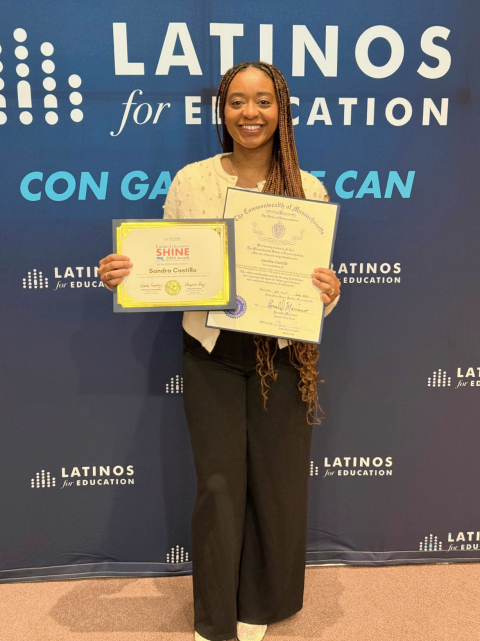
Sandra Castillo '17 received a 2026 Latino Educators Shine Award for her work supporting student success, fostering cultural pride and making an impact in her classroom and community. Photo courtesy of Christopher O'Donnell
I had a faint thought that maybe teaching was something I could do. But honestly, the idea goes back to childhood. I would set up a whiteboard in my living room and pretend to be a teacher. My cousins were my students, and I would even assign them weekly homework!
At Bucknell, though, I was more drawn to economic policy and development. One course that really shifted my perspective was The Economics of Race. It pushed me to think more deeply about how race, class and economics shape people's experiences and opportunities. I wanted to connect what I was learning to the communities I care about. Looking back, that interest in people, communities and systems played a big role in leading me toward education. Becoming a teacher wasn't necessarily my plan, but all the pieces were already there.
What appeals to you about math?
Math was always my favorite subject. I loved that there was often one right answer but so many ways to get there. I like the critical thinking and puzzle-solving — figuring out how to get from one point to another and understanding the reasoning behind it. As I became more comfortable with math, I grew more confident in my ability to work through challenges.
That interest continued at Bucknell, where I applied mathematical concepts and economic theories to real-world problems. I began to see math as a tool for understanding the world around me. That's a perspective I now try to bring into my classroom.
How did you go from economics to teaching?
I liked how economics went beyond the numbers and allowed me to explore policy, systems and economic development. At Bucknell, I studied everything from health policy and labor to climate change, inequality and international affairs. I fell in love with making the numbers mean something more — using them to understand people, communities and the systems that shape our lives. I also mentored children and tutored students in math, which showed me how much I enjoyed working with young people.
After interning in the U.S. Department of the Treasury's Office of International Affairs, specifically the Office of China and East Asia, I graduated and returned to Salem to work in the city's economic development office. I'm a big community person, and while I valued that work, I wanted a more direct, personal connection to the people I was serving. I became the director of a project-based after-school program for middle school students. Working with students brought me back to something I'd always loved: helping young people learn, grow and build confidence. Teaching brought together my love of math, my background in economics and my passion for making an impact in my community and with the next generation. Looking back, each experience brought me one step closer to where I was meant to be.
How do you help students build confidence in math?
I see so many students come in with a negative narrative about themselves: "I'm bad at math. I can't do this." A huge part of my work is helping them rewrite that narrative and understand that being good at math is something they can develop. I celebrate small wins and encourage collaboration. You don't have to have the right answer to contribute. One student might get us started, another might take us a little further, and someone else might help us reach the solution. Together, we can get there. I want students to leave my classroom knowing more math and believing they can do hard things.
What is the best part of an average school day?
The best part is connecting with the kids. There's never a dull day — it's middle school! Sixth grade is a huge transition. They're navigating a new environment, figuring out friendships and learning who they are. There's definitely some drama along the way, and it feels meaningful to help them navigate it. I teach math, but the job is so much more than that. I help students work through challenges, ask for help and advocate for themselves. Then there are the small wins: seeing a student understand something they struggled with or contribute to a class discussion. You can see the moment something clicks. Their eyes light up, and they start to believe in themselves. Those moments make the job so purposeful to me.
Were there experiences at Bucknell that shaped the way you think about community today?
As a Posse Scholar, I had a community of support before stepping foot on campus. I came to Bucknell with peers and mentors who helped me navigate being at a prestigious university, especially as a first-generation college student. That support made a huge difference.
I was also part of the Bisonettes, Bucknell's dance team. I went through difficult family circumstances during college, and dance gave me a safe space to feel, process and heal. When I didn't have the words to express how I felt, I could express myself through movement. The Bisonettes became a community I could lean on. Between Posse and dance, I learned that community takes many forms. Sometimes it's people who help you navigate challenges, sometimes it's serving others, and sometimes it's having a space where you belong. Those communities helped me persevere at Bucknell and continue to shape how I think about community today.
What does receiving the Latino Educators Shine Award mean to you so early in your teaching career?
It honestly gives me goosebumps. I'm grateful to have people see the work I'm doing in the classroom. To me, this award reflects all the experiences that have shaped me — the successes, the challenges, and everything in between. The challenges taught me to persevere, find my voice, advocate for myself and recognize when I need help. Those are the same values I try to instill in my students.
As a student, I was figuring out where I belonged and was fortunate to find communities that supported me and helped me discover my purpose. Those experiences taught me how powerful it is to feel seen and have people in your corner. They inspired me to serve the communities that have poured into me. Now I get to create that same sense of belonging and possibility for my students. This award is a reminder of what I hope to represent for them: someone who looks like them, understands where they come from and shows them success is possible. If a student can look at me and think, "She did it, so maybe I can too," then I feel like I'm making an impact.

