Christine Ngo, Economics
January 22, 2026
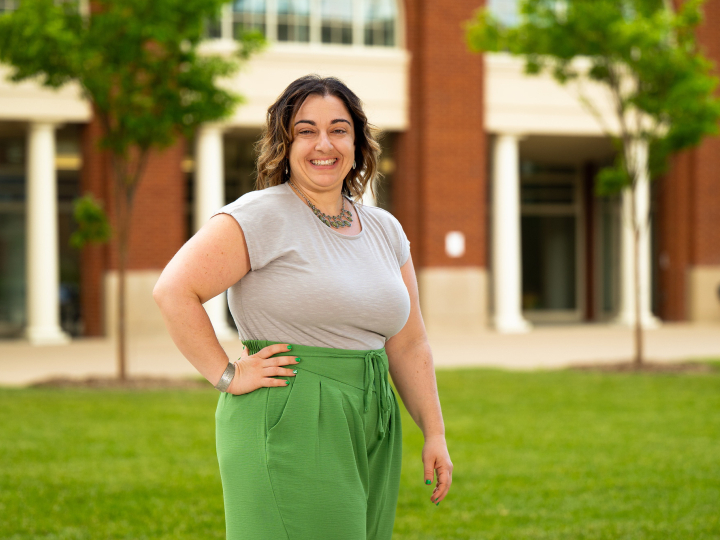
Professor Christine Ngo, economics, is conducting research that explores the intersection of policy and economic development. Photo by James T. Giffen, Marketing & Communications
"Of all the universities in the U.S., Bucknell probably has the largest concentration of political economists who have real expertise and active research agendas in the field. It's the kind of department that rivals large research institutions, so I was really excited to join so many colleagues that are doing interesting research."
Like gravity, the economy is also something of an omnipresent force. Not everyone can explain how it works, though that doesn't mean we aren't subject to its influence. However, Christine Ngo, economics, has devoted her career to demystifying how the largest, most complex systems in our world impact our daily lives.
"Broadly speaking, there are two different approaches to the study of economics," says Ngo. Mainstream economics, which tends to rely on quantitative methods, focuses largely on issues of market efficiency and individual rationality. Political economy, Ngo's speciality, is an interdisciplinary branch of political science and economics that relies on mixed methods of qualitative research and historical analysis to explain the complex relationships between government, society, political systems and the economy.
After completing her law degree at the University of California Law San Francisco, and her doctorate in economics at the School of Oriental and African Studies, University of London, Ngo first joined the faculty at the University of Denver before arriving at Bucknell in 2018.
"Of all the universities in the U.S., Bucknell probably has the largest concentration of political economists who have real expertise and active research agendas in the field," says Ngo. "It's the kind of department that rivals large research institutions, so I was really excited to join so many colleagues that are doing interesting research."
One of Ngo's main research areas is development economics, which examines the fiscal, social and economic conditions in developing nations. "One thing I'm always interested in is the role corruption plays in the development of an economy," she says.
In her research, she's not solely interested in the volume of money being embezzled within a system. "I look at group dynamics, as well as how politics play a role in influencing key agents within those groups that make a decision based on the corrupted amounts that they earn."
To answer questions about how policy and economic development are influenced by corruption, Ngo spent more than a decade collecting data in Vietnam. However, then the COVID-19 pandemic hit and shut everything down. "That was when I shifted the focus of my work from Vietnam to rural economic development in central Pennsylvania."
By focusing on counties throughout the Susquehanna Valley, Ngo studied how the pandemic impacted local, small businesses. Much of her data collection involved conducting interviews with businesses throughout the region to better understand how employer-employee relationships and work-life balance were altered because of the pandemic.
"In the immediate aftermath of the pandemic, employers were appreciative of their workers for their willingness to sacrifice and perform during a very difficult time," says Ngo. "Now that the pandemic is behind us, my question is focused on whether those changes in the workplace and that initial appreciation has continued."
For Ngo, her focus on central Pennsylvania isn't simply a matter of geographical convenience; it's an effort to shed light on a region that receives less attention from the economics field as a whole.
"Within economics, there has been a bias towards studying the large cities, a field known as urban economics. There's a lot less interest in understanding what's happening in rural America," she says. "I'm hoping my research can help us better understand the rural-urban divide as well as culture war issues we've been experiencing."
At Bucknell, it's not just world-class colleagues that shape Ngo's political economy research. She also collaborates closely with students in and out of the classroom, and works with a research assistant every summer to collect data and develop and publish papers.
Among her favorite courses to teach are International Economics and the Economics of Innovation, which explores the intersection of technology and economic systems.
But it's not just the big, complex issues that Ngo teaches them to investigate. "The relationship I build with students here is more of an adviser-advisee relationship than a traditional student-faculty one," says Ngo. "I'm also helping them navigate internship and job applications and what comes next after college."