Bucknell Study Finds Cold Climates Protect Animals Against Damage from Extreme Temperature Swings
December 11, 2025
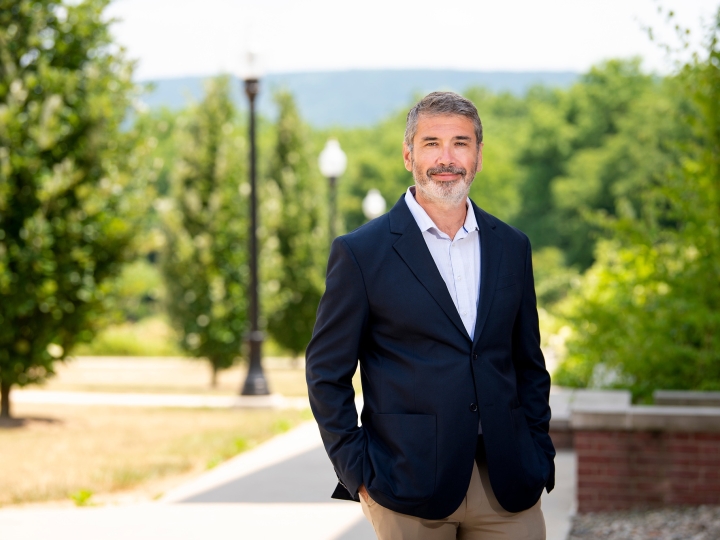
Professor Mark Haussmann, biology, has been studying the links between oxidative stress and aging for more than 10 years. Emily Paine, Marketing & Communications
Bucknell University biology researchers are shedding new light on how animals cope with the accelerating impacts of climate change and, potentially, accelerated aging. A recent study co-authored by Professor Mark Haussmann and students from his lab reveals that organisms native to colder climates are better protected from the harmful physiological effects triggered by extreme temperature variance than those adapted to warmer environments.
Published Sept. 26 in the Journal of Experimental Biology, the study adds to a growing body of work exploring how temperature fluctuations — increasingly common as the climate warms — can cause oxidative stress, cellular damage and potentially hasten aging across species.
Probing How Temperature Extremes Impact Physiology
"As seasons shift and weather turns colder, organisms experience significant physiological challenges," Haussmann says. "In my lab, we study the physiological and molecular underpinnings of aging and how these traits influence survival and lifespan."
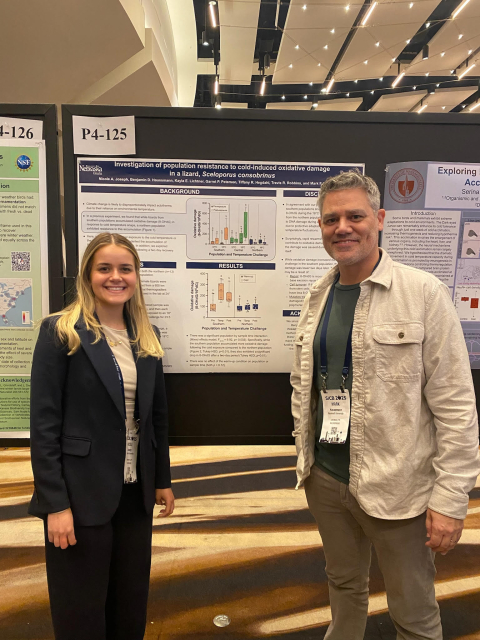
Nicole Joseph '25 stands with Professor Mark Haussmann after presenting on the prairie lizards and extreme temperature research at the Society of Integrative and Comparative Biology national meeting in Atlanta in January 2025. Photo courtesy of Mark Haussmann
The study's lead author was Haussmann’s nephew, Benjamin Haussmann, now a biology doctoral student at Auburn University. Conducted as part of his master's work at the University of Nebraska Omaha, the research focused on prairie lizards — an ectothermic species that spans a vast latitudinal range from Canada to Central America. Because they warm themselves using environmental heat rather than internal sources, prairie lizards experience temperature swings acutely, making them ideal for studying climate-related stress.
The researchers found that lizards from the southern portion of the species’ range, where temperatures remain relatively stable year-round, showed greater signs of oxidative stress when exposed to sudden cold. In contrast, northern lizards — long adapted to harsher seasonal swings — mounted stronger protective responses.
"Higher levels of oxidative damage are implicated in a large number of diseases," Haussmann explains. "Our study shows that temperature extremes influence that damage. As these extremes become more widespread, populations not traditionally exposed to these temperatures may lack mechanisms needed to defend against them — setting the stage for selection."
Four Bucknell students contributed as co-authors, including Nicole Joseph '25, now studying to become a medical doctor at the Lewis Katz School of Medicine at Temple University; Kayla Lichtner '24, currently in Bucknell's master's program. Redeit Woldebirhan '24 and Benjamin Travis '22 were the other two Bucknell authors.
Expanding Research North: Studying Storm-Petrels on Kent Island
Joseph, Lichtner, Sarah Chapman '25, currently enrolled in Bucknell's master’s program, and Tori Chace '26 are also part of Haussmann's ongoing research into oxidative stress and telomere dynamics in storm-petrels on Kent Island, a North Atlantic field station owned by Bowdoin College. Supported by a $1 million National Science Foundation grant, the team spent this past summer studying these seabirds.
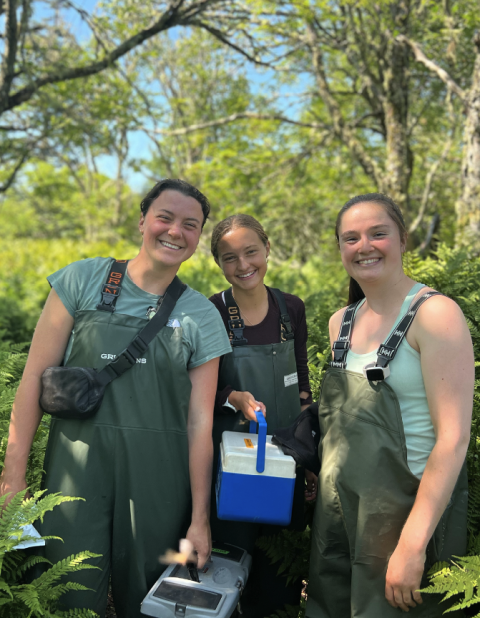
Kayla Lichtner '24, Tori Chace '26 and Sarah Chapman '25 (L to R) are part of the ongoing research looking into oxidative stress and telomere dynamics in storm-petrels on Kent Island. Photo by Mark Haussmann
Storm-petrels, a mouse-sized seabird, can live up to 40 years — an astonishing lifespan given their small size and energetic demands. Their longevity and peculiar life history make them a valuable model for understanding the trade-offs species make between growth, reproduction and long-term survival.
"We're trying to understand the underlying mechanisms contributing to their success and longevity," Lichtner says.
Her own research examines how early life stress shapes long-term outcomes — questions that have inspired her to pursue a doctoral degree. in the future. "My research is focused on mitochondria and metabolism." She adds, "I am investigating how individuals are able to efficiently produce energy, which provides insight into how they are able to supply energy for growth, reproduction, and maintenance."
Training the Next Generation of Scientists
For Haussmann, the connections across species, climates and student experience are central to his lab's mission.
"By collaborating with peers at different stages in their careers and researchers from other universities, my students gain a realistic window into how science is conducted and the unique opportunities that Bucknell provides," he says.
Whether examining lizards grappling with abrupt cold shocks or seabirds thriving for decades in harsh island conditions, Bucknell student researchers are uncovering how diverse species meet the challenges of a changing climate — and what resilience looks like across the natural world.