Bucknell Study: Stress Hormones Drive Seabird Chicks to Rapid Siblicide
April 22, 2026
Professor Morgan Benowitz-Fredericks (left) and students Eadaoin Kelly '22 (center) and Sierra Pete M'23 (right) at the Middleton Island Marine Biological Station. Photo by Sierra Pete
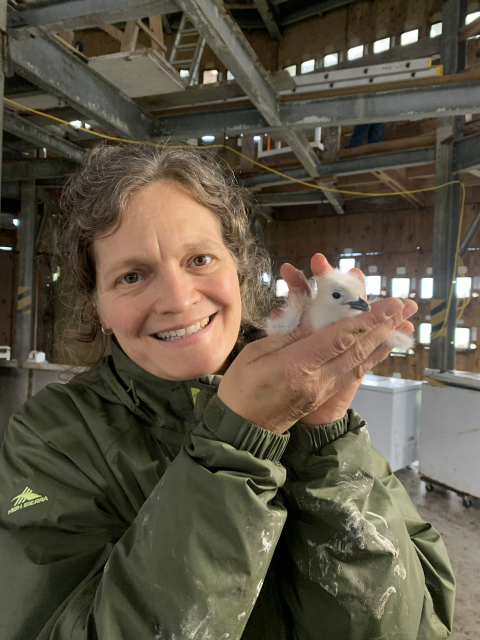
Professor Morgan Benowitz-Fredericks, biology, and director of the animal behavior program, holds a black-legged kittiwake chick. Photo courtesy of Morgan Benowitz-Fredericks
Long before they take their first flight, black-legged kittiwake chicks face a stark choice: compete or die.
New research led by Bucknell University Professor Morgan Benowitz-Fredericks, biology, and director of the animal behavior program, reveals that heightened levels of corticosterone, a stress hormone, can push these young seabirds toward extreme aggression, even killing their siblings in the nest.
"What makes people excited about our lab's research is that these baby seabird chicks are adorable white cotton balls, and yet they're murderers through siblicide," Benowitz-Fredericks says. "It's repulsive and fascinating at the same time."
Published in the April edition of the journal Hormones & Behavior, the study explores how hormones and behavior interact in real time in wild animals. Of the five authors, three are former Bucknell biology students: Sierra Pete M'23, Stephanie Walsh '24 and Alexis Will '06.
Scientists have long suspected a two-way relationship between hormones and behavior — each influencing the other. But experimental evidence in free-living animals has been rare. This study helps fill that gap.
Tracking black-legged kittiwakes
The research takes place on Middleton Island in the Gulf of Alaska, where an abandoned military site now serves as a seabird research station. Since 2016, Benowitz-Fredericks has worked with Bucknell students and collaborators to study how environmental conditions shape seabird biology and behavior.
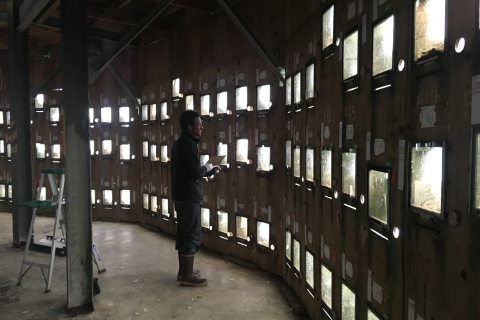
The Middleton Island Marine Biological Station is managed by the Institute for Seabird Research and Conservation and used by teams of scientists from all over the world. Photo by Morgan Benowitz-Fredericks
Black-legged kittiwakes (Rissa tridactyla) return to the same nesting sites each year, offering a unique opportunity to observe wild birds from the earliest stages of life.
"These chicks coexist with no sign of aggression at first," Benowitz-Fredericks says. "But that can change quickly. If they're going to get aggressive and kill a sibling, that often occurs in the first 10 days."
In many nests, two chicks hatch. When food is scarce, the older chick may attack the younger in a behavior known as facultative siblicide — a strategy driven by environmental conditions.
"The most obvious factor is resource limitation," she says. "They're hungry, and there's not enough food to go around."
Hormones and behavior in real time
To understand what drives this behavior, researchers conducted two experiments. In the first, they observed chicks and measured corticosterone levels before and after a mild stressor. Chicks that had received fewer feedings showed stronger hormonal responses and became more aggressive within the next hour.
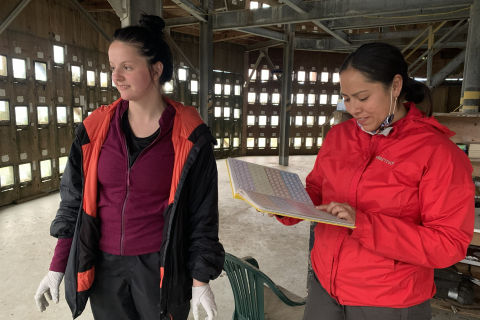
One of the study's authors Sierra Pete M'23 (right) prepares to collect data at the Middleton Island research station with Eadaoin Kelly '22 (left), who is also acknowledged in the paper. Photo by Morgan Benowitz-Fredericks
In a second experiment, researchers applied corticosterone directly to chicks. The results confirmed that elevated hormone levels increased aggressive behavior.
"Hormones increase the probability of certain behavioral responses, but only in the proper context," Benowitz-Fredericks says.
The study also shows how quickly these changes can occur. "People usually expect steroid hormones to take hours to days to influence behavior," she says. "Our study is unusual because it looked for (and found) a really rapid change."
Survival in a changing environment
"At five days of age, these little cotton balls have a wildly high capacity to produce these hormones," Benowitz-Fredericks says. "The question is, why do they have such a strong response? Maybe it's about siblicidal behavior."
Chicks with higher corticosterone responses were more likely to eliminate siblings quickly, reducing competition and improving their own chances of survival.
But this relationship depends on context. In nests where researchers provided supplemental food — part of a long-term experiment — the link between stress hormones and aggression disappeared. With resources abundant, the hormonal trigger for siblicide was effectively muted.
The research also suggests broader developmental effects. The team found sex-specific differences, with male chicks showing stronger links between corticosterone and aggression — even before other sex differences emerge.
Overall, the findings highlight how physiology, behavior and environment intersect to shape survival, especially as food availability becomes less predictable in a changing climate.
"We're studying development of the stress response and how it connects to behavior in real time," Benowitz-Fredericks says.
On Middleton Island, where seabirds return year after year, these interactions offer a rare window into how animals adapt, compete and survive from their earliest days.