Engineering and Computing Conference Brings Alumni Career Insights to Campus
October 5, 2026
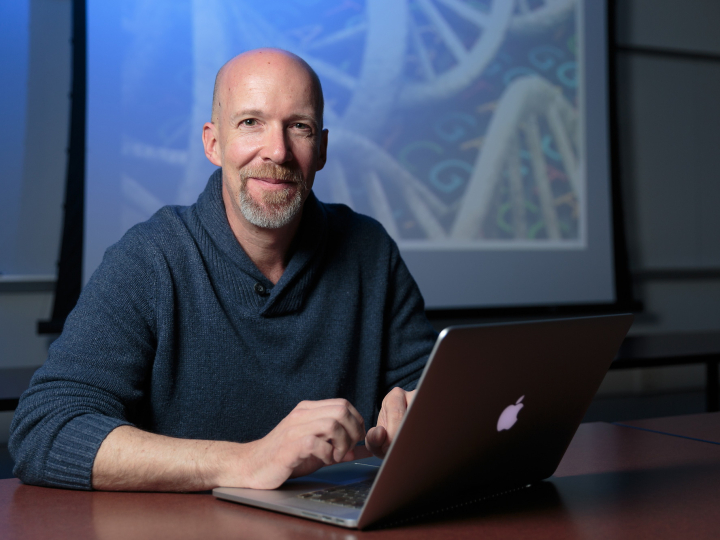
Jordan Rice '02 connects with students at Bucknell's Engineering & Computing Career Connections Conference, an on-campus event designed to help students build career confidence and professional connections. Photo by Emily Lamparter, Marketing & Communications
At Bucknell's Engineering & Computing Career Connections Conference (EC⁴), students could ask an executive about an unexpected career turn, talk with a recent graduate about their transition into the workplace or simply practice introducing themselves. The conversations felt like those at a professional conference, but this was in a familiar campus setting, with faculty and alumni there to help students find their footing.
Organized by the College of Engineering with support from the Center for Career Advancement and University Advancement, EC⁴ brought more than 70 Bucknellians back to campus Sept. 24, including leaders from across engineering and technology sectors. First held in 2025, the event featured alumni panel discussions and several open networking sessions, giving students opportunities to hear career advice and then continue those conversations face-to-face.
Chemical engineering major Pheodora Kasmer '28 found the conversations easier than she expected. "I was surprised how comfortable it was talking to people who are so high up in their careers," she said. "It helped me see that these are real people who do real jobs. I liked being able to connect with them in a way that didn't feel intimidating."
That experience is part of EC⁴'s purpose. Students who feel shy or uncertain can work through those first-conversation jitters here, then carry that experience into a larger career fair, professional conference or interview.
Across the conference, alumni offered students these lessons about building a career.
Be Open to a Change of Direction
Jordan Rice '02 opened EC⁴ with a message that resonated throughout the day: Careers rarely unfold in straight lines. Rice is vice president for Nike Innovation Portfolio & Partnerships, and is serving this year as Innovator in Residence at Bucknell's Perricelli-Gegnas Center for Entrepreneurship & Innovation.
After graduating with an electrical engineering degree, Rice admitted: "I didn't know exactly what I wanted to do." His early role at Nokia Bell Labs in New Jersey was stable and well-paid — but he wasn't learning enough. He left it for a lower-paying role all the way across the country in Seattle.
That decision, he said, was driven by a simple principle: "Optimize for learning density. I wanted to accumulate learning density over the course of a year at a time," he said. "Look for work that challenges you and allows you to grow."
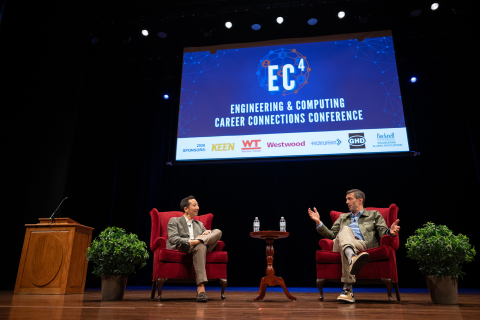
A conversation between Jordan Rice '02 (right) and Professor Charles Kim, mechanical engineering, kicked off Bucknell's Engineering & Computing Career Connections Conference. Photo by James T. Giffen, Marketing & Communications
Early Career Risks Can Pay Off
Rice encouraged students to explore opportunities that may seem risky while they have the flexibility to do so. "You are at the most-able-to-take-a-risk moment in your life when you graduate from college," he said. "You don't have a mortgage. You don't have kids. Nothing is weighing you down. Go for it. You will learn a ton." He said he believes the riskier move is to pursue roles that have limited opportunities for growth. Those carry their own long-term risk, he said.
Josh Mull '06, senior technical program manager at Amazon Prime Video, described the thrill of working on a startup early in his career. "Startups can be really adventurous," he said. "You need to put yourself out there and do some things that you might not be comfortable doing. Some people really enjoy that and enjoy the learning that comes with it. There's a mentality that is very exciting — that you figure it out as you go."
The Bucknell Network Makes Risk Feel Safer
Throughout EC⁴, alumni emphasized how Bucknell connections shaped their own success. Rice credited a fellow Bucknellian for helping him land a pivotal early role. Panelists echoed the view that Bucknell's alumni network is unusually active and supportive, creating a foundation that students can rely on as they explore new opportunities.
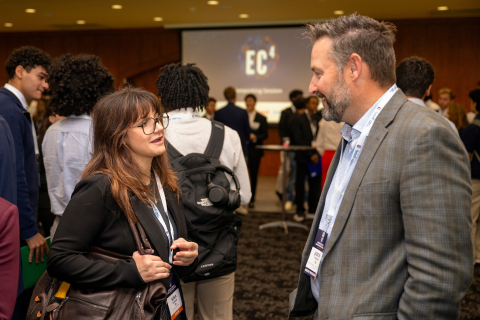
Students and alumni connect during a networking session. In response to feedback from students who attended last year’s conference, organizers added more networking sessions to this year's schedule. Photo by Emily Lamparter, Marketing & Communications
Failure Isn't a Red Flag on a Resume
Panelists agreed: Failure is not something to hide. It's an opportunity to share something valuable about yourself. "If a candidate can articulate what they learned from that experience, it's a huge asset," Mull said.
Rice agreed: "Trying something ambitious, even if it didn't work out, demonstrates initiative, resilience and curiosity."
Innovation Requires Systems Thinking — Not Just Technical Skills
Rice framed engineering careers in a way that applies to students across engineering majors. Nike's complexity as a company, he explained, isn't just in designing shoes or gear; it's in managing a global supply chain that produces more than a billion products a year. "It's really a massive systems problem," he said.
Having a systems-engineering mindset — the ability to see connections, anticipate constraints and collaborate across disciplines — is increasingly essential in today's engineering roles.
Soft Skills Are A Huge Differentiator
Across sessions, alumni emphasized communication, writing and relationship-building — skills prioritized at Bucknell — as critical to their careers.
Rice put it simply: "One of the big cheat codes in the real world is that a lot of success comes down to showing up and being a good person to work with."
Shane Coudriet '26, applications engineer at Lee Industries, described joining a company where many colleagues have decades more experience. Taking time to learn their names, ask about their work and listen to their answers has helped him understand the workplace. As those relationships grow, he has found it easier to share his own ideas.
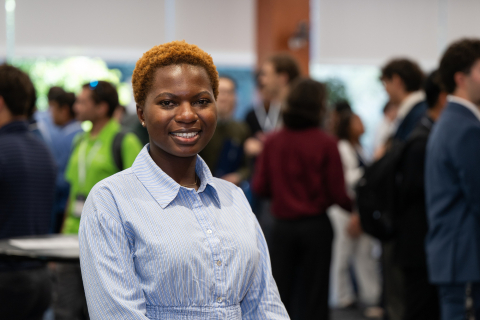
Simbi Maphosa '23 returned to campus for Bucknell's Engineering & Computing Career Connections Conference and participated in the "Post-grad Reality Check" panel about life after Bucknell. Photo by James T. Giffen, Marketing & Communications
Simbi Maphosa '23, discovery engineer at LSI Solutions, also encouraged students to take a genuine interest in their coworkers. She described how observing experienced colleagues and asking about their work has led to opportunities to contribute and build new skills.
"People love talking about what they do," she said. "When I had time, I would talk to a colleague whose work I really admired. I would ask questions about his design process, what he does, and learn these little tips and tricks." When he later needed help, she said, those conversations made him more likely to think of her.
Unexpected Credentials on Your Resume Can Open Doors
Coudriet encouraged students to include campus experiences on their resumes, even when those activities may not seem directly related to the job they want. His time as Bucky Bison and president of Bucknell's Coffee Club gave employers something to ask him about, and gave him an opening to show his personality and interests, things that may not come through in a list of technical qualifications.
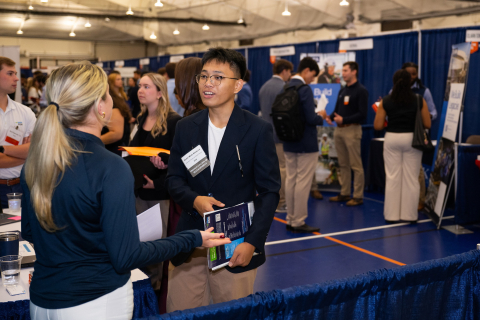
Students connect with employers and explore opportunities in STEM and business at the career fair held as part of Bucknell’s Engineering & Computing Career Connections Conference. Photo by James T. Giffen, Marketing & Communications
Classroom Experiences Pay Off
For Maphosa, Senior Design and an independent research project gave her valuable experiences she could discuss in job interviews. She also credited the writing and presentation skills she developed at Bucknell with helping her succeed at work.
Two weeks into her job, her manager asked her to present two unfamiliar products to a room of about 50 surgeons. "He goes, 'You look like someone who can talk. You’re going to present on these two products,'" she said. While it was daunting, she knew she could do it. "The only reason I was prepared to do it was that I had done so many presentations at Bucknell," she said.
AI Raises the Bar for Discretion, Not Output
While many panelists noted how valuable AI has been in their industries, they also emphasized that it makes critical thinking even more important. Rice said that while AI can make it easy to generate content, he said that "people sometimes don't realize how transparent it is. The ability to assess and edit and refine it — not just produce it — is what really matters."