Herbarium Records Lead Bucknell Researcher to New Plant Species in Australian Outback
January 5, 2026
Professor Chris Martine in the Rooke Science Building greenhouse, which has some plants he brought back from Australia. Photo by Emily Paine, Marketing & Communications
A study led by Bucknell University Professor Chris Martine, biology, Burpee Professor in Plant Genetics & Research, has identified a new species of bush tomato in Australia's Northern Territory, a discovery sparked by unusual specimens preserved for decades in herbarium collections.
The study, published in the open-access journal PhytoKeys, was co-authored by Australian botanists and Jason Cantley, a former Burpee Postdoctoral Fellow in Botany at Bucknell who is now an associate professor of biology at San Francisco State University. It highlights the role of natural history collections in biodiversity research.
The new species, Solanum nectarifolium, known as the Tanami Bush Tomato, is named for the northern edge of the Tanami Desert, where it was first collected and for the conspicuous nectar-producing organs on the undersides of its leaves.
Martine first suspected something unusual while building an evolutionary tree of Australian bush tomatoes using DNA from herbarium specimens. Working with former Burpee Postdoctoral Fellow Angela McDonnell, now an assistant professor at St. Cloud State University, he noticed two samples identified as the same species — Solanum ossicruentum, or Blood Bone Tomato — repeatedly appeared in different parts of the tree.
"We couldn't understand why the same species kept showing up in two places,” Martine says. "I knew one specimen was correctly identified, so I contacted the botanist who collected the other one to ask if it might be something different."
That botanist, David Albrecht of the Northern Territory Herbarium, suggested revisiting the remote northwestern Tanami Desert. Before heading into the field, Martine examined records through the Australasian Virtual Herbarium, which catalogs plant specimens from across Australia and New Zealand. He found 15 collections from the Tanami region dating back to 1971 — all geographically isolated from other known populations.
In May 2025, Martine traveled to Australia with Cantley and co-authors Kym Brennan, Aiden Webb and Geoff Newton, all affiliated with the Northern Territory Herbarium. Before the expedition, Martine examined specimens at the Western Australian Herbarium in Perth.
"They looked a lot like Solanum ossicruentum, but there was one thing I'd never seen before," Martine says.
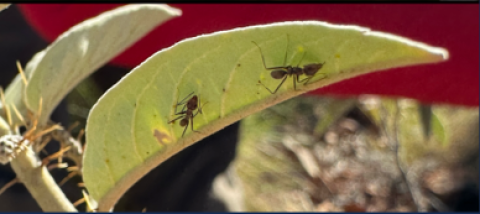
The Tanami bush tomato has conspicuous nectar-producing organs on the undersides of its leaves that secrete sugary liquid to attract ants that defend plants from herbivores. Photo by Chris Martine
Along the veins on the undersides of the leaves were small, round disks — visible without magnification — found only on specimens from the Tanami region. Martine suspected they were extrafloral nectaries, structures that secrete sugary liquid to attract ants that defend plants from herbivores. While such nectaries are known in a few bush tomatoes, they are usually microscopic.
The same structures appeared on specimens at the Northern Territory Herbarium in Palmerston. One of the most recent collections, from 2021, had been made by Brennan, who showed Martine photographs of leaves covered in glistening nectar droplets.
After more than 1,000 kilometers of driving, the team reached a site about 50 kilometers southwest of Lajamanu, where the species had been collected since the 1970s. The plants were abundant and in flower.
As the researchers documented the plants, they observed ants swarming the leaf undersides and feeding from the disks, confirming the function of the nectaries.
The species name "nectarifolium" translates to "nectar leaf." Experts confirmed that no other species in the genus Solanum — which includes tomatoes, potatoes and eggplants — is known to have extrafloral nectaries visible to the naked eye.
Bucknell's Wayne E. Manning Herbarium now houses specimens of the Tanami Bush Tomato, though the official holotype remains at the Northern Territory Herbarium.
"These collections let us study where species occur, how they change over time and, sometimes, help us discover entirely new ones," Martine says.
The discovery comes amid growing concern about the future of natural history collections, including Duke University's recent announcement that it will close its herbarium.
Martine was recently elected president-elect of the Botanical Society of America and will begin his term following the society's annual meeting in August 2026.
"It still doesn't feel real and probably won't until I start my term," Martine says. "But I promise to do my best because plants are awesome and so are botanists."