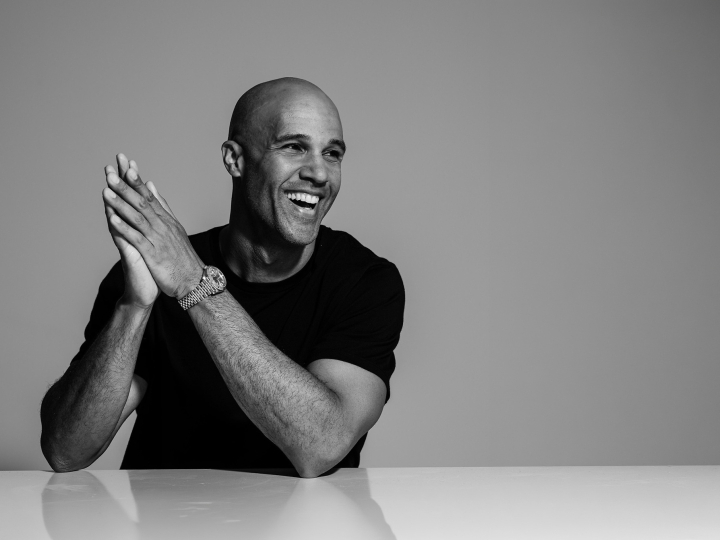
Joel Boyd '79, M'80, Biology
February 9, 2026
Joel Boyd '79, M'80, the NHL’s first Black team physician, has kept the Minnesota Wild’s toughest athletes healthy and performing at their best for over two decades. Photo courtesy of the Minnesota Wild
For more than two decades, Joel Boyd '79, M'80 has been a fixture in hockey health. As the longtime orthopedic surgeon for the NHL's Minnesota Wild — and the first Black team physician in NHL history — Boyd has kept some of the sport's toughest athletes on their skates.
He is serving as head physician for the U.S. men's ice hockey team at the Winter Olympics in Milan, the latest chapter in an Olympic career that began at the 1998 Games in Nagano, Japan.
Why did you choose Bucknell?
I was recruited to play football. I came for a visit in the spring and just fell in love with the setting. The whole atmosphere around Bucknell felt right.
Did you always plan on becoming a doctor?
I considered being on a pre-med track, but my adviser thought it would be too much on top of football. So I majored in biology. Not being pre-med enabled me to settle in at a little bit of a slower pace. It was a smart decision.

Joel Boyd '79, M'80 brings decades of expertise to his role as head physician for the U.S. men's hockey team at the Winter Olympics in Milan. Photo courtesy of USA Hockey
Were there mentors who shaped your path?
Absolutely. Sally Nyquist, a biology professor, was incredibly influential. Her encouragement convinced me to get my master's at Bucknell and then pursue medical school. John Bergfeld P'60, P'86 took me under his wing at the Cleveland Clinic, where I did my residency. We became really close — people called him Big JB and me Little JB.
How did you first get interested in hockey?
I grew up in Washington, D.C. When the Washington Capitals joined the NHL in 1974, they drafted Mike Marston — the second African American NHL player. My friends and I would go to games just to see him play.
What drew you specifically to orthopedics?
I wanted a career where there would be a definitive treatment — where I could fix people, not just monitor them. In orthopedics, you treat someone, see the results and get them back to doing what they love.
How did Minnesota shape your hockey career?
Minnesota is basically the most Canadian state in the U.S. — hockey is king here. There are ice rinks in every community. That's where I became immersed in the sport and eventually became head physician for the state high school league.
What are the most common injuries you see in hockey?
Lacerations are the most common — from skates, pucks or fights. Skates are razor sharp; I've seen skates to the neck, with some very close calls. Pucks fly everywhere, often into painfully sensitive spots. These players are like small cars moving at 40 miles an hour, with pucks flying at 90.
Is hockey really as tough as people say?
I think hockey is the toughest sport. The season is long and grueling, and there's a lot of humility in the culture. Most players fly under the radar, and I think that keeps them grounded.
What about hockey might surprise people?
While coaching football at the University of Western Ontario during a medical fellowship, I traveled across Canada and was stunned to learn that ice hockey's origins trace back to African Canadian church leagues in Halifax, Nova Scotia, in the late 1800s. Hockey's roots are more layered than people realize.
How has hockey become a family affair for you?
My daughter is vice president of the Seattle Kraken. One son is director of community outreach for the Kraken, and my other son coaches youth hockey in Seattle. So yes, they're all into hockey — which is great. Except when the Wild play the Kraken. Then it gets a little chippy.