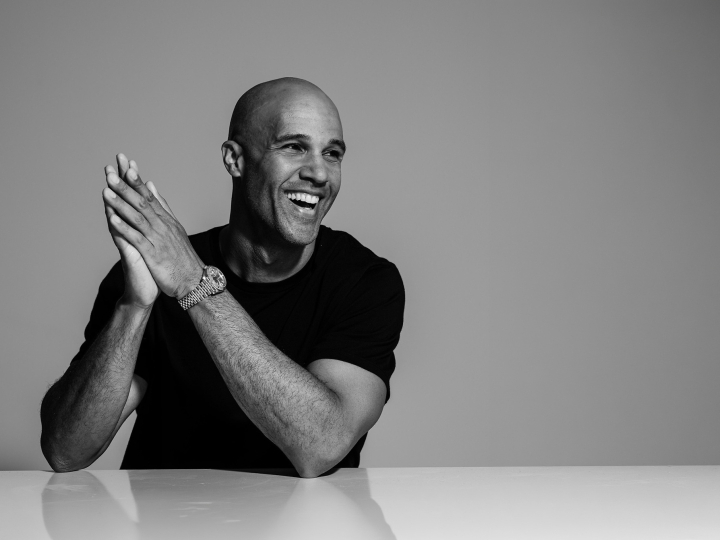
Chris Gregory '18, Theatre, Animal Behavior, and French
February 17, 2026
Chris Gregory '18 is channeling his Bucknell-born passion for service into a health care career, training future EMTs while working toward a career as a pediatric physician. Photo by James T. Giffen, Marketing & Communications
Chris Gregory '18 did it all in college — worked six jobs, triple majored in theatre, animal behavior, and French, designed lighting for performances, was a varsity cheerleader, and minored in dance. But ultimately, he distilled his broad interests into one career goal: helping others.
Since graduation, Gregory has worked as an emergency medical technician instructor in San Leandro, Calif., teaching more than 900 students and developing policy to improve care. He is currently in medical school at the Touro College of Osteopathic Medicine with plans to work in pediatrics to continue pursuing his passion for education through healthcare.
His drive to turn wide-ranging interests into meaningful service earned him recognition as one of the Bucknell Alumni Association's 2025 30 Under 30 honorees. (Bucknell alumni are invited to nominate classmates for the 2026 recognition.)
With your wide variety of interests, what draws you to pursue medicine?
I chose Bucknell because it was the school where I thought I could do the most theatre while also getting a liberal arts education. In my first year of college, I had the opportunity to design the lighting for an entire dance showcase on my own. I took a class on animal behavior because of the science requirement, and I loved the subject. My theatre classes were artistic, and the animal behavior sciences got my brain working.
However, by my senior year, I realized that theatre was enjoyable, but it did not give me the same sense of purpose that healthcare did.
I was drawn to medicine mainly because I love helping people. I also love the intellectual aspect of anatomy and physiology, and saw that it could sustain my passion throughout a career. I've been working in pre-hospital emergency medicine for almost 15 years now, and I believe that being able to remain calm and help someone in an emergency is a valuable contribution to society and the people around you. I'm currently pursuing a degree in osteopathic medicine to become a physician with specialized training in manual manipulation. Osteopathy effectively uses anatomical knowledge to treat individuals and address root causes rather than just symptoms, placing the body in a position to heal itself best.
Where does your passion for teaching others come from?
I was diagnosed with a learning disability in second grade, so I understand what it's like to struggle in school. In high school and college, I learned not to focus solely on grades, but rather to care about whether I truly understood the material, and I had to understand how I learn best. Throughout college, I realized that I learn best by teaching. To teach someone else, you must know the material extremely well. That paired well with theatre, because theatre is about presenting people with a thought-provoking idea and convincing them it is true — same with teaching! Teaching necessarily has additional aspects, like exams, but by remembering that the goal is for the audience to walk away with newfound truths, a good educator can craft exams that further teach the material.
When I started teaching at the Bay Area Training Academy, my goal was for my students to become the best EMTs possible, so my grading reflected not only how much they understood but also how well they applied their knowledge. I gave points back on exams if students could explain why the right answer was correct and the others were wrong. I found that really reinforced understanding — and why shouldn't you get credit for learning, even if it was after an exam? I've taken many tests where I studied the wrong material and felt frustrated after leaving the exam. Becoming an educator, I studied everything from the students' perspective and attempted to streamline the process so that students could focus on the material.
In EMS, you can't have learning gaps. You can't just say, "I didn't do well in that chapter; I'll just avoid those patients." So, anything I can do to help students build up their skills and be successful, I do.
What has been your proudest career accomplishment so far?
My students. In an ambulance, I can treat around eight patients a day. If I teach someone, they can treat not only eight patients a day, but can continue treating additional patients for years and years. I have personally certified about 900 EMTs across 33 classes. I have served as a guest lecturer in countless other classes. I've been an administrator for thousands of students, and every single one of them is going to go off and treat more patients. In that respect, I am involved in the treatment of thousands of patients. Some of my previous students are now doctors, nurses, technicians, and even teachers! They're making a difference for more patients than I could ever touch alone.
A strong emphasis in my classes is self-care. EMT work affects clinicians personally. It is worthwhile to teach others to care for the sick and injured, but that education is lacking without an emphasis on provider stress management, burnout recognition and mitigation, and self-confidence building. Looking back on my past moments, the most rewarding are when I can help a student overcome their challenges and succeed when they thought they would fail.
What experiences at Bucknell contributed most to your career?
I had six jobs while I was at Bucknell. I was a technical assistant in the Department of Theatre & Dance and a manager at Uptown. I was a student emergency medical driver for public safety. I worked briefly for the departments of languages and admissions. One of my most unique jobs was as a pastry chef for the campus dining provider. In my freshman year, I wanted to learn how to bake, so I approached the dining office and asked if I could bake for them. With enough persistence, they eventually said yes, and I had the opportunity to spend years perfecting my chocolate strawberry! I was a varsity cheerleader, earned three majors and a minor, and volunteered as a firefighter in Lewisburg — the experience that ignited my passion for helping others and set my trajectory toward becoming a physician.
I learned exceptional time management skills from Bucknell. Now that I'm in medical school, I'm balancing coursework with a full-time job, commuting, and self-care. I don't think I would have been able to be successful with this much on my plate if I hadn't been thoroughly tested at Bucknell!