Joe Wilck, Analytics & Operations Management
July 1, 2026
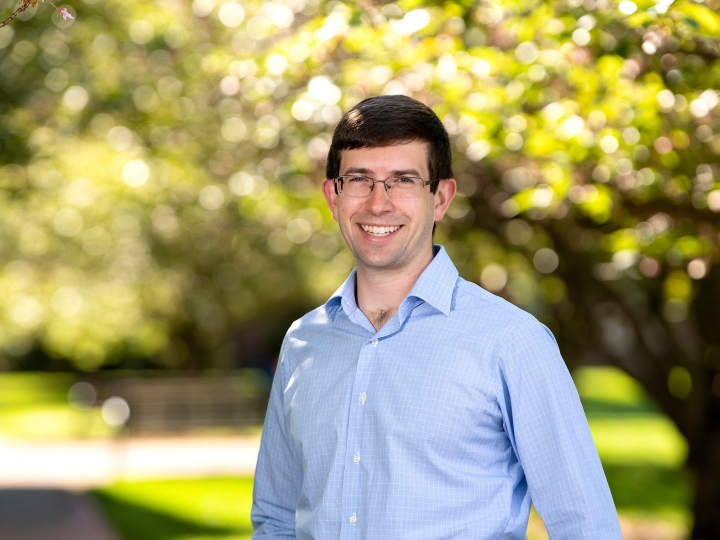
Professor Joe Wilck, analytics & management, brings an engineer's systems-thinking mindset to business analytics. Photo by James T. Giffen, Marketing & Communications
An engineer in a management school might seem unexpected. But Professor Joe Wilck, analytics & operations management, has built a career at the intersections.
Trained as an industrial and systems engineer, with a doctorate and early faculty roles at major research universities, Wilck began his professional life rooted in engineering and operations research. Today, he teaches business analytics in the Freeman College of Management — applying the same quantitative rigor to organizational decision-making that he once brought to engineering systems.
The shift isn't as dramatic as it sounds. At heart, Wilck is a systems thinker — someone who designs processes, not products — and that perspective translates seamlessly across disciplines. At Bucknell, where collaboration across colleges is not just encouraged but embedded in the culture, he doesn't feel like an outlier. He feels at home. In many ways, his career embodies the University's interdisciplinary mindset.
Wilck grew up on a cattle farm in Farmville, Va. When he came home from college, he knew one thing for certain: He didn't want to return to farm work. So he interned at manufacturing facilities every summer. Still, he found that he did miss the rhythms of farm life, a connection that resurfaced years later in Lewisburg, where he and his family now live next to full-time farmers.
At Virginia Tech, Wilck wanted to pursue engineering, but wasn't sure what kind of engineer he wanted to become. He attended information sessions and visited the career center to study placement data by discipline. That's when he discovered industrial and systems engineering, specifically operations research — a field he didn't know existed.
"Once I learned about it, it just fit how my brain works," he says.
Unlike disciplines that focus on designing a single product — a bridge, an engine, an aircraft — industrial and systems engineering focus on processes. How do you design a system that works efficiently over and over again? How do you improve it?
That question — how to improve a system — defines his career.
Wilck went straight into a master's program, worked for the Department of Defense as a civilian, and later earned his doctorate at Penn State, where he discovered something unexpected: He loved teaching. He found that he enjoyed the energy of the classroom and he had a knack for explaining complex ideas clearly.
His first faculty role was at the University of Tennessee, a major research institution. Excelling there meant prioritizing research and teaching fewer classes, "and I missed teaching," he says.
That realization led him to smaller institutions and eventually to Bucknell, where the teacher-scholar model felt like the right balance.

Looking back, I think I should have gone to a school like Bucknell. I really see the value of a smaller school and the opportunities for students here.
Along the way, he also made a disciplinary shift. As business schools began building programs in analytics and data science in the early 2010s, they needed faculty fluent in quantitative models. Wilck's engineering background and teaching mindset made him a natural fit.
Today, he teaches analytics and operations, applying quantitative tools to improve real-world systems.
His research is wide-ranging by design.
I try to improve systems using analytics, data science and artificial intelligence. If there's a system, I want to improve it.
In sports analytics, he uses publicly available data to model performance and develop strategies. In healthcare, he has partnered with Geisinger to improve clinical processes, helping to manage wait times and visualize referral flows. In a new state-funded project with a Penn State colleague, he will study rural manufacturing in Pennsylvania, surveying manufacturing companies to understand their adoption of automation and AI, and advising them on how to improve their operations.
At Bucknell, he values how faculty go out of their way to mentor students and how the institution invests in making that possible through research centers and funding. Through initiatives like the Dominguez Center for Data Science, he's seen how Bucknell intentionally bridges disciplines across its three colleges — creating opportunities for undergraduate students that don't always exist at bigger schools.
"Looking back," he says, "I think I should have gone to a school like Bucknell. I really see the value of a smaller school and the opportunities for students here."