Bucknell Engineering Students Take on Project to Protect Prosthetic Limbs of Winter Parathletes
February 12, 2026
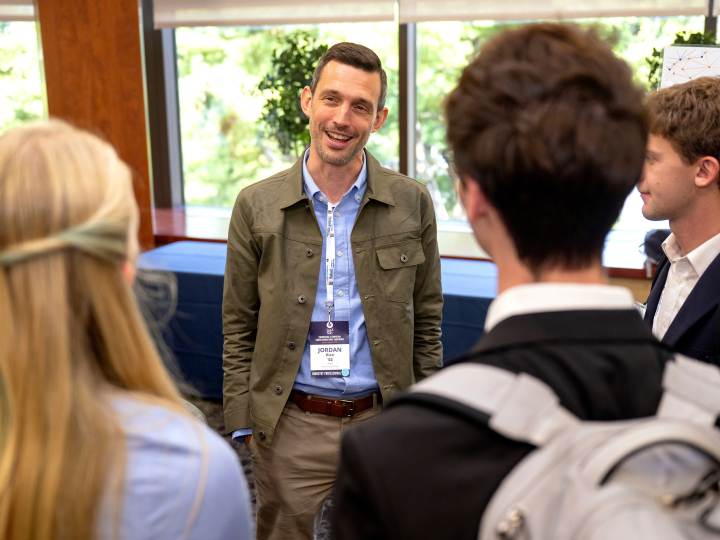
World Cup skeleton parathlete medalist Kevin Bittenbender (center) discusses the prototype with Senior Design team members Macy Volp '26 (right) and Jordan Kenton '26 (left). Photo by Emily Paine, Marketing & Communications
In the winter Olympic sport of skeleton, athletes race face-first down a twisting track of ice at speeds nearing 80 miles per hour, steering with subtle shifts of body weight just inches from unforgiving walls.
For parathletes, the danger is compounded. Prosthetics and residual limbs exposed to extreme cold can lead to pain, swelling, loss of sensation — or serious injury — during one of the fastest sports on ice.
That challenge is the focus of a Senior Design project by a team of Bucknell University mechanical engineering students competing in Project S.E.R.V.E.'s National Design Competition. The competition is being conducted in conjunction with the US Parasliding development committee. The Bucknell team is one of 12 nationally developing a temperature-regulation device for residual limbs worn by winter parathletes, working directly with World Cup skeleton parathlete medalist and retired Army Sgt. Major Kevin Bittenbender — an amputee who recently won two bronze medals in skeleton at Winter Para-Skeleton World Cup events in Norway and Switzerland.
A Natural Senior Design Project
Professor Benjamin Wheatley, mechanical engineering, is the faculty adviser of the Bucknell Senior Design team of Macy Volp '26, Jordan Kenton '26, Mert Guney '26 and Tim Robertson '26 — all mechanical engineering majors. Team members found this project to be natural for both their experience and engineering design interests.
"As an engineer, the idea is to provide value by improving health," says Volp, the project lead. "Applying engineering to athletics for people with disabilities gives us the opportunity to make a real impact on many individuals. For me, it seems like a valuable combination of a lot of interests, and I feel fortunate to be a part of it."
Project S.E.R.V.E. (Students Engineering Resilience of Veterans and Emergency Responders) is a 501(c)(3) organization that has improved the lives of veterans and emergency responders living with injuries or disabling conditions through student-led engineering projects, pairing real-world beneficiaries with multidisciplinary student teams to develop practical, human-centered solutions.
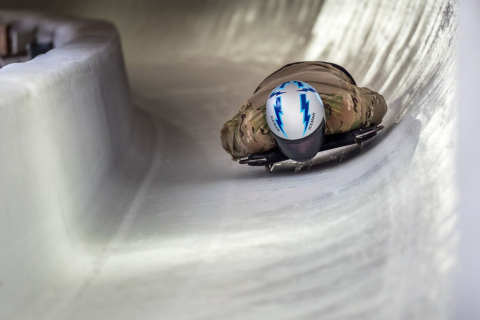
Kevin Bittenbender competes in a skeleton competition. Photo courtesy of Kevin Bittenbender
Bittenbender resides in nearby Montgomery, Pa., and has frequently been honored at Bucknell sporting events for his military service. He was paired with the Bucknell team by Project S.E.R.V.E. as a veteran and winter parathlete who could advise them and guide them in the design.
For Bittenbender, who lost his leg while serving in the Army, managing temperature is critical in sliding sports.
"When you have a residual limb exposed to extreme heat or cold, it can be detrimental, particularly when you have residual feeling," Bittenbender says. "After competition, my prosthetic limb has either swollen or shrunk. Maintaining a balance of heat is important. The fewer limbs you have, the less circulation you have."
Those realities present complex engineering challenges. The Bucknell team has chosen an electrically-powered heating mechanism, requiring careful consideration of moisture, impact, safety and strict temperature limits — especially because many prosthetics are made from thermal plastics.
"There are many complications. Moisture, contact with walls and extreme temperatures all factor into the design," Volp says. "Those complications really drive our decision-making."
Getting the Full Sliding Experience

The Bison Battle Buddies at Lake Placid (L to R): Professor Benjamin Wheatley, Jordan Kenton '26, Macy Volp '26, Kevin Bittenbender, Tim Robertson '26 and Mert Guney '26. Photo courtesy of Benjamin Wheatley
To better understand the environment their device must withstand, the team took their design work to the ice, volunteering at last weekend's (Feb. 6–8) U.S. Nationals World Cup skeleton event in Lake Placid, N.Y., where Bittenbender was competing. While their primary role was loading and unloading sleds at the start and finish lines, the experience extended beyond volunteer duties. The team viewed the course with Bittenbender, observed training and competition routines, gathered feedback from parathletes and coaches, and experienced skeleton firsthand in the ice house push track (see video below).
"The goal was to see how the athletes go through practice and competition and how a device like this would actually be used," Wheatley says. "We gained an appreciation for the temperatures, the environment and the realities athletes face."
The impact of the team's final design may extend beyond a single athlete or sport. Bittenbender believes successful designs could help expand access to sliding sports — including skeleton, bobsled and/or luge — and other Paralympic winter sports such as cross-country skiing, downhill and biathlon, among others, strengthening the case for their inclusion in the 2030 Paralympic Winter Games in the French Alps.
"This project itself has impacted each individual on the team," Bittenbender says. "It's a win-win situation."
The Bucknell team calls itself B3 — the Bison Battle Buddies.
"This is something Kevin learned on the battlefield; small comfort items can make a huge difference in harsh conditions," Volp says. "We're honoring the battle buddies when they're out in the cold."
Project S.E.R.V.E. National Design Competition finals will bring all 12 teams to Virginia Tech April 25 and 26. To learn more about the organization, the design competition, and its capstone projects, please visit projectserve.org.
Getting the Full Skeleton Experience
Tim Robertson '26, shown here, and members of the Bucknell team experienced skeleton firsthand at the Lake Placid ice house push track. Video by Benjamin Wheatley