Engineering Access: How Bucknell Students Created a Makerspace Solution
January 26, 2026
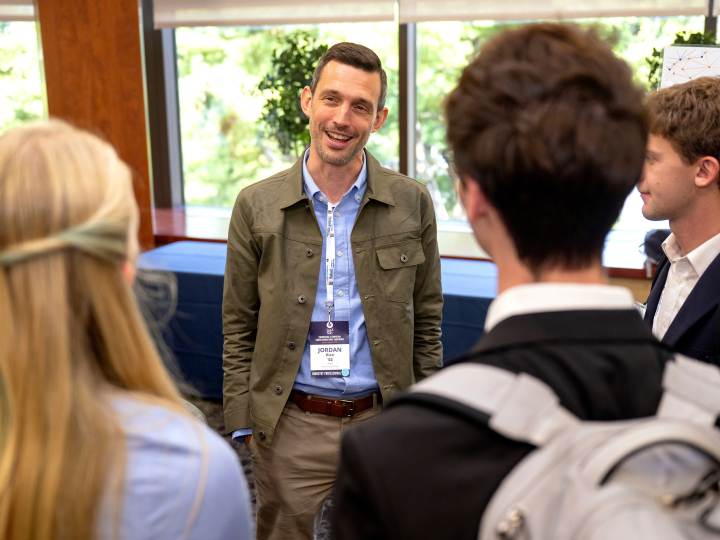
Eli Foster '27, Matt Lamparter '06 and Aiden Cherniske '27 (left to right) collaborated to develop the fifth evolution of the Portal Box. Photo by Emily Paine, Marketing & Communications
Bucknell's makerspaces operate under a guiding philosophy of open access, empowered creativity and smart accountability. That approach is most clearly embodied in the Portal Box — a student-built access system that has evolved through multiple generations of makers and engineers.
It started in 2015 as a Senior Design project in collaboration with Professor Margot Vigeant, chemical engineering. Her vision was simple: create a device that could grant or restrict access to equipment based on a user's verified proficiency. The team succeeded, and the first Portal Box was born.
A decade later, that prototype has become a fully integrated access platform used in several of Bucknell's makerspaces, including the Maker-E and Mooney Innovative Design Laboratory, as well as in the chemistry department's electron microscopy suite.
In summer 2025, Aiden Cherniske '27, a computer engineering major, and Eli Foster '27, an electrical engineering major, led the development of its fifth and most recent evolution — one focused on accessibility, efficiency and wider deployment.
How It Works
The Portal Box system controls access to equipment that requires verified training. It consists of three parts: a physical access point (glowing acrylic boxes) that regulates equipment use, embedded software that manages and records user interactions, and a database and web portal that tracks training and activity — a result of the invested work of Tom Egan '02, who plays a crucial role in the web-based applications of the project. Users insert radio frequency identification cards into the box to activate equipment. If training is complete, the box glows green and grants access.
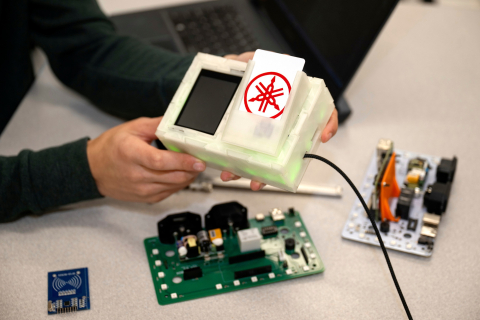
The Portal Box lights up green when a student with verified training taps their RFID card. Photo by Emily Paine, Marketing & Communications
Maker-E staff and managers oversee the system through an online database, where they can add users, update access and track usage. As it has evolved, the project has embraced the collaborative spirit of the maker community — it is open source, free and available to any lab in need of a smart access solution.
"The Portal Box is effective and inexpensive," says Matt Lamparter '06, director of electrical & computer engineering laboratories and current leader of the Portal Box project. "We know the broader maker community could benefit from our design."
New Developments
During the spring 2025 semester, Lamparter guided a group of Senior Design students on significant upgrades to the box. Axel Andrews '25, Colton Jiorle '25, Kevin Duong '25, Aidan Flynn '25, James Powick '25 and Peter Beaudette '25 worked to integrate an intuitive touch-screen display to gather user feedback and allow for multi-factor authentication.
That vision guided Cherniske and Foster as they developed version five of the system. They upgraded the microcontroller for better WiFi compatibility and connectivity, installed an affordable touch screen display and identified less expensive parts to bring down the overall build cost. By remapping the circuit board and redesigning the box, they created the smallest, most modular version yet — one that functions like a jigsaw puzzle, enabling users to swap out components and customize the setup.
"If another university or maker space wants to implement something that will serve them better, they can design new pieces for the sides of the case," says Foster. "Then they can share it with others to keep expanding the project."
Lamparter presented the latest iteration of the Portal Box at an international makerspace symposium in August. He found that all makerspaces face the same problem — balancing access against accountability — and many have found their own customized solution. "There are a lot of similarities in how we operate," he says. "I'm excited to explore ways to collaborate."
"Our work feels like continuing a legacy of everyone who has ever worked on this box," says Cherniske. "It just keeps getting better and better."