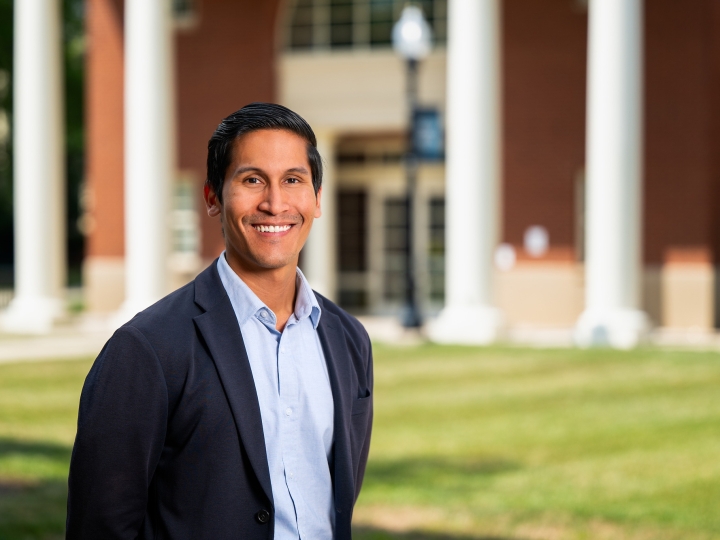
Annie Ross, Computer Science
December 4, 2025
Professor Annie Ross, computer science, places digital accessibility at the center of her research and pedagogy. Photo by Emily Paine, Marketing & Communications
"I want to supplement that technical knowledge with an advocacy skillset so students are able to make the legal, equity and business case for accessibility."
Life in the 21st century means that the world — and all it has to offer — is literally at your fingertips. Pull up a web browser on your phone and find answers to burning questions in a matter of seconds, or fill a virtual cart full of groceries from your laptop and wait for them to be delivered to your front door. In less than half a century, technology like the internet has given most people on Earth quick access to almost anything they can imagine. However, an increasingly digitized world is not necessarily the same as a more accessible one.
"My research before coming to Bucknell was about how often accessibility failures are happening not only in mobile apps but more generally in technology," says Professor Annie Ross, computer science.
Ross didn’t always know where her education would take her. As an undergraduate, she dabbled in everything from film production to computer science and human-computer interaction. When she applied to graduate school, she cast a wide net, with an eye toward disciplines such as robotics, crowdsourcing and large screen interactions. But it was upon arriving at the University of Washington where she found her home in large scale studies of digital accessibility.
"I came up with this conceptual framework where I was drawing from epidemiology — the study of disease in a population — but instead of focusing on people, I was thinking about a population of technology: apps and websites," says Ross, who received a graduate fellowship from the National Science Foundation to bolster her research. "And instead of a disease, I was thinking about inaccessibility as something that can spread from different sources."
During her dissertation research, Ross identified areas in Google’s public documentation and tutorials that were missing accessibility features, and worked with the company to update their documents. Her research was later cited by the Americans with Disabilities Act as part of a process to update national accessibility legislation.
When she arrived at Bucknell in 2021, Ross was excited to expand her digital accessibility research and pedagogy. She created a digital accessibility elective within the computer science department designed to appeal to not only juniors and seniors within the major, but students across the University. "I've structured it to make it more broadly open to all types of students," says Ross. "We've had students from management enrolled, and I’m hoping to grow it more and more."
Ross’s elective aims to provide students with the historical background of disability advocacy and activism while also giving them the technical skills they need to build a more accessible world. "I've actually structured it around industry standards, with the idea that digital accessibility is a marketable skill," says Ross. "I wanted to create an elective that is as actionable as possible for them to take forward, either as accessibility specialists or just in whatever career they end up in."
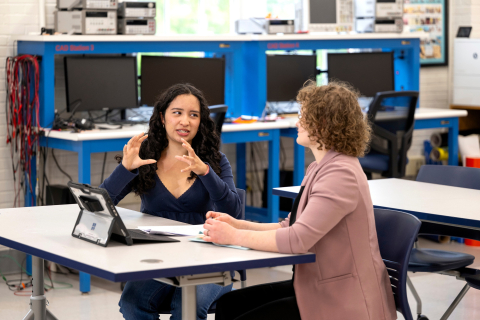
Aura Chuck Hernandez '27, a computer science and English—literary studies double-major, is working with Professor Annie Ross, computer science, to advance accessibility research. Photo by Emily Paine, Marketing & Communications
Ross works closely with students on impactful research. Together, they have conducted projects to advance accessibility standards both on campus and beyond. "One student wrote a guide on how to write alt text for images that Bertrand Library posted as part of their resources," says Ross. Other students have written digital accessibility guides that are distributed throughout the Small Business Development Center.
With the support of grants from the National Science Foundation Career Life and Research Initiation and the Mozilla Responsible Computing Challenge, she and student researchers have collaborated with area small businesses to better understand how to improve digital accessibility awareness and education. In addition, they have investigated the experience of burnout in accessibility specialists.
For Ross, accessible design is synonymous with good design, and this principle animates her desire to integrate digital accessibility education into her curriculum. The liberal arts foundation at Bucknell gives her the room to approach the subject from a human-centered perspective while also making sure students have the skills required to advocate for and implement accessible solutions across their chosen fields.
"I want to supplement that technical knowledge with an advocacy skillset so students are able to make the legal, equity and business case for accessibility," she says.