Pennsylvania's Data Center Boom Raises Big Questions About Power, Water and AI
September 8, 2026
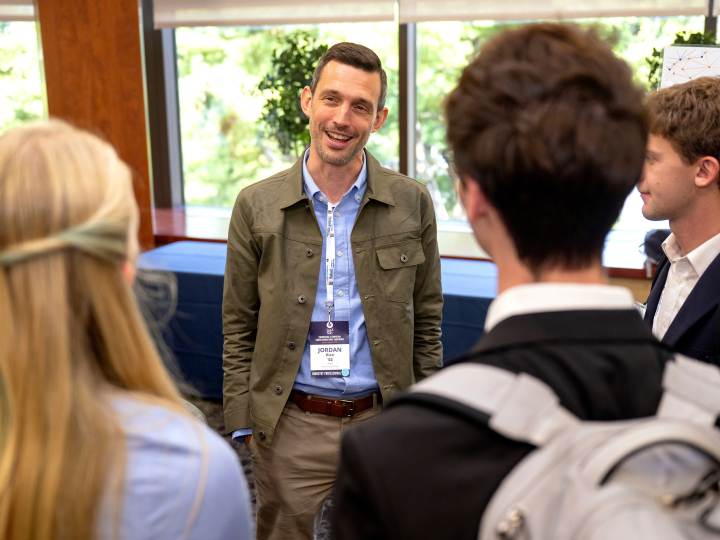
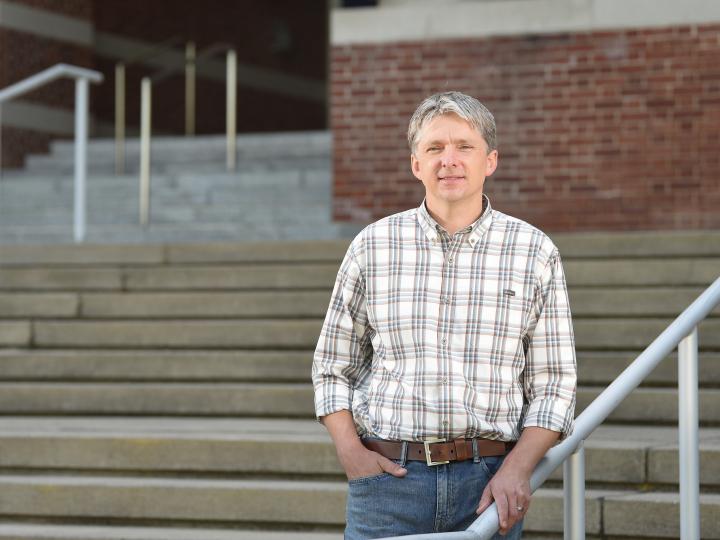
Professor Brian King, computer science, is one of the three Bucknell experts who agree that the the debate over data centers reflects a complicated reality. Photo by Brett Simpson
The artificial intelligence (AI) revolution may seem to live in the cloud, but the cloud has a very large — and increasingly visible — physical footprint.
Across Pennsylvania, proposals are emerging for massive data centers filled with processors and memory needed to power AI tools such as ChatGPT, Claude and Gemini. As communities such as Archbald and nearby Allenwood confront questions about their enormous electricity and water demands, development costs and local impacts, the proliferation of data centers is quickly emerging as a key political issue heading into this fall's midterm elections. Data center development has accelerated so rapidly that Gov. Josh Shapiro put new guardrails on data center development with an Aug. 18 executive order.
Three Bucknell University experts say the debate reflects a complicated reality: AI's seemingly effortless answers require enormous amounts of electricity, computing equipment and potentially water.
Professor Brian King, computer science, Xin Faculty Fellow in Computer Science & Engineering and faculty fellow for the Dominguez Center for Data Science, says Pennsylvania is particularly attractive to developers because of its combination of available land, energy resources and location.
"Pennsylvania is one of the largest electricity exporters, so we’re looked at as a pretty good power resource," King says. "Our grid is pretty strong because we've developed so much power and export it. In order to do that, we have to have a pretty solid infrastructure to support that."
Pennsylvania also sits near major East Coast population centers and has natural gas and nuclear generation already in place. But AI is dramatically increasing what computing demands from that infrastructure.
The Power Drain
King points to U.S. Department of Energy estimates showing that in 2023, data centers alone were consuming 4.4% of all U.S. electricity, but in 2028 because of the proliferation of AI, that will be up to 12%.
"That's like 180 terawatt hours (equivalent to 180 trillion watt hours) — that's a lot of big cities being sent to the data centers," King says. "Globally, there's a doubling."
A traditional Google search around 2010 might have required roughly 0.04 watt-hours, King says, while estimates for a ChatGPT query have been considerably higher. More sophisticated AI models require powerful graphics processing units, or GPUs, and enormous amounts of memory, often distributing a single request across multiple machines.
"That consumes a massive amount of power," King says. "Looking at the grid alone, I would think that would really put some substantial stress on the grid."
King says one solution may be using smaller, specialized AI models instead of enormous "frontier" models for every task. Research has suggested that smaller models and shorter prompts could reduce AI energy consumption substantially.
"If we can change to these fine-tuned models for specific tasks, you can get just as much accuracy and a substantial reduction in power usage," he says. "That's huge, and we shouldn’t turn a blind eye on this."
Straining Natural Resources
The environmental equation extends well beyond electricity, says Benjamin Hayes, program director of watershed sciences & engineering in The Ecology Center.
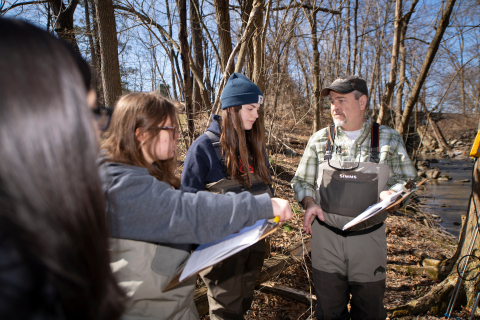
Benjamin Hayes, program director of watershed sciences & engineering in The Ecology Center, teaches his stream ecology class. Photo by Emily Lamparter, Marketing & Communications
Modern data centers operate continuously and generate tremendous heat, requiring cooling systems that may consume large quantities of water. While their direct water use represents a relatively small portion of national withdrawals, Hayes says impacts must be evaluated locally.
"A withdrawal of 100,000 gallons a day may not seem like a lot, but if it is in a small watershed, that could have a much more serious impact to the local aquatic environment," he says. "Some facilities may require as much as a million gallons of water a day, which would exceed available resources."
The concern compounds because data centers also require tremendous electricity, meaning water may be needed both to cool the centers themselves and the power plants generating their electricity.
"With every data center request, there are two main aspects," Hayes says. "One is the water use of the data center itself — how it goes about cooling — but then the bigger question is that new electricity demand coming into the grid. Where's that power coming from?"
Load Management
Professor Lily Li, mechanical engineering, and the Jane W. Griffith Faculty Fellow, studies electrical-grid demand response and says another emerging question is whether computing loads might eventually become more distributed rather than concentrated in enormous facilities.
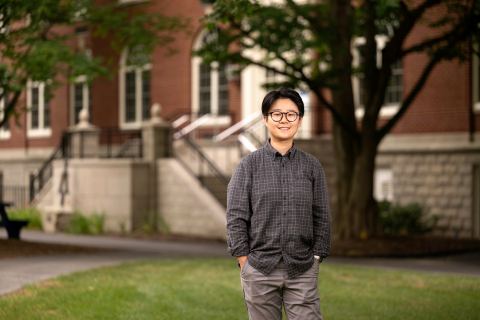
Professor Lily Li, mechanical engineering, and the Jane W. Griffith Faculty Fellow. Photo by Emily Lamparter, Marketing & Communciations
The concept could potentially save developers infrastructure costs and time, she says, but decentralization raises questions about coordination, equipment capabilities and who controls privately owned resources.
"Centralized work is never simply the sum of all decentralized resources," Li says.
For Pennsylvania, those questions are becoming increasingly urgent. Shapiro's executive order requires developers to cover new generation and grid costs rather than shifting them to other ratepayers, while also requiring environmental protections, transparency and community involvement.
For King, the larger challenge is balancing AI's extraordinary capabilities against costs that users rarely see when they type a prompt.
"This technology is so powerful, so transformative and so disruptive to so many industries," he says. "We have a lot of work ahead. We need to provide structure for people to better understand how to use them safely and effectively, while providing solid guardrails to protect people, especially kids and their learning."