
Philip Onffroy '22, Chemical Engineering
September 8, 2026
Philip Onffroy '22 received a prestigious scholarship from Stanford University, where he is currently studying chemical engineering. Photo by Emily Lamparter, Marketing & Communications
As a Bucknell rower, Philip Onffroy '22 spent long stretches on the water — time that gave him a sense of calm. But seeing pollution invade that landscape left a lasting impression and inspired his determination to develop environmental solutions.
Drawn to chemical engineering at Bucknell for its blend of fundamental science and real-world impact, Onffroy began conducting research as a first-year student. A first-year seminar focused on philosophy broadened his thinking about scientific problems. He ended up adding a philosophy minor, which he credits with sharpening his ability to communicate complex ideas and to consider the human side of technical work.
"I realized I really liked thinking about how people think," he says. "That understanding helps me explain science in a way that people can actually connect with."
That combination of technical expertise and human-centered thinking continues to shape Onffroy's work. Now in the fourth year of his doctoral program in chemical engineering at Stanford University, he researches sustainable materials for energy and environmental applications.
A former captain of Bucknell's rowing team, he also earned recognition as a Goldwater Scholar, National Science Foundation Graduate Research Fellow and a Knight-Hennessy Scholar.
What first drew you to Bucknell?
I committed during an Admitted Students Day. I was undecided before visiting, but I just fell in love with the campus. I walked into the admissions office and signed right there. I had toured larger research universities and technical schools. But at some of those places I felt like I'd be lost in the crowd. Bucknell felt different.
Why did you add a philosophy minor?
It really started with my first-year seminar — it was about the philosophy of magic. We talked about how people perceive and interpret things. I realized I really liked thinking about how people think. That has helped me a lot as a scientist, because it forces you to communicate more clearly and be more empathetic when explaining complex ideas.
How did Bucknell shape your research path?
I started research right away in my first year. Bucknell made it easy to get involved early. I worked in Professor Kat Wakabayashi's materials lab and finished part of an existing project. It was an established project started by other students, so it was a great opportunity to gain exposure and understand research before my sophomore year. Then Professor Wakabayashi said, "Okay, it's time that you start your own project and think of something new that we can figure out together." So I was very fortunate to have both of these experiences — an established, structured project with defined goals. And then my own independent project, where I really learned to be an independent thinker.
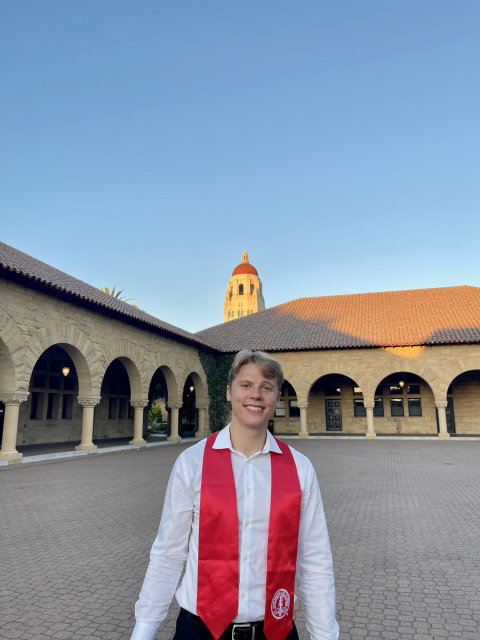
Now in the fourth year of his doctoral program in chemical engineering at Stanford University, Philip Onffroy '22 develops materials that support more sustainable systems. Photo courtesy of Philip Onffroy '22
What has motivated your focus on sustainability?
I'm pretty passionate about leading teams that make scientific contributions to make sustainable manufacturing routes easier and less expensive. I think the reality of the world is that you can have really cool science, and you can have really cool sustainable research, but when it comes down to whether things will actually be implemented, what really matters is cost and how easy it is to transition a society that's so used to one type of way of doing things. So you need to make it easy for society or an industry to switch over. The way to do that is to make scientific advancements that incentivize a smooth transition to happen, whether that's using a cheaper method or making it easier, like using materials that are easier to access. To make real changes, you have to ask how we can make the green solution easier.
And honestly, I care about it personally. I love nature. I love rowing. I've seen waterways all over the world. I feel at peace in nature. Here at Stanford, I row in the San Francisco Bay. I get to see the beauty of nature in waterways. But then I also see when there's waste in the water. It's that dichotomy — nature makes me feel at peace, but when I see pollution, it just makes me mad and drives me to action.
You've received major fellowships, including a Goldwater and an NSF award. What role did Bucknell play in that?
Without Bucknell, I don't think I would have been competitive for those fellowships. It wasn't just the research — it was learning how to talk about my work. I think that combination of learning how to be a researcher — and being a high-integrity, careful researcher — with the opportunities to talk about my research prepared me very well for later applying to fellowships. Not only was I gaining experience in the lab, but I also learned how to articulate what I'm doing in the lab outside the lab. I think that made a huge difference.
What are you working on now at Stanford?
When I came to Stanford, I rotated through a few labs and became especially excited about using polymers for sustainable energy. I still care deeply about recycling plastics and bio-derived materials, and I've continued working on a few smaller projects in the recycling space. But the main focus of my thesis shifted toward applying similar polymer systems in new ways — for example, as electrode materials for batteries used in electric vehicles, and even as fuel containment structures for nuclear fusion applications.
Part of my thinking was: Graduate school is a chance to broaden my portfolio of expertise. I wanted to build on what I knew while also pushing into new areas like battery science and fusion energy. I'm still driven by sustainability, but I also wanted to stretch into fields that I hadn't worked in before.
What comes next for you?
A couple of my first papers during my Ph.D. were on brand-new material systems, and we filed a few patent applications. I've been involved in three patents, which has been an exciting process because it takes the research out of just the academic space and starts to ask what it could become in the real world.
Right now, I'm exploring whether my work could become a company through an accelerator program. If the timing is right, I might spin out a startup. It's been interesting to think not just about whether something works scientifically, but whether it actually works economically and at scale. That's a different kind of challenge, but an important one. If not, I'd be excited to lead research in sustainable materials in industry or at a national lab. I'd also consider faculty work. I want to stay in spaces where I can build things that matter.