Bucknell Center for Sustainability & the Environment Renamed The Ecology Center
March 16, 2026
Watershed Sciences & Engineering Program Scientist Sean Reese (center) directs Kit Jackson '24 (left) and Professor Stewart Thomas (right), electrical & computer engineering, on mussel research in the Susquehanna River. Photo by Emily Paine, Marketing & Communications
The Bucknell Center for Sustainability & the Environment will transition this month to a new name, The Ecology Center, to better reflect the center's interdisciplinary approach to addressing complex environmental and societal challenges.
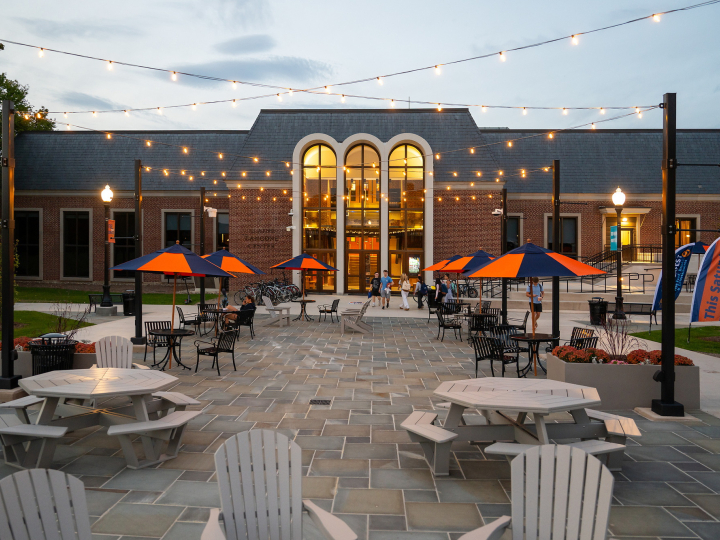
The announcement comes as the center celebrates its 20th anniversary and prepares to host one of its signature events, the 13th Annual Sustainability Symposium, on Thursday, March 26, from noon to 5:30 p.m. in Bucknell's McDonnell Commons. This year's symposium theme, "Tree Networks: Trees as Social, Ecological and Technical Beings," will feature keynote speaker Dr. Beronda Montgomery, author of When Trees Testify: Science, Wisdom, History, and America's Black Botanical Legacy.
Center leaders say the name change better reflects the broad ways the center engages environmental issues through science, technology, the humanities and community partnerships.
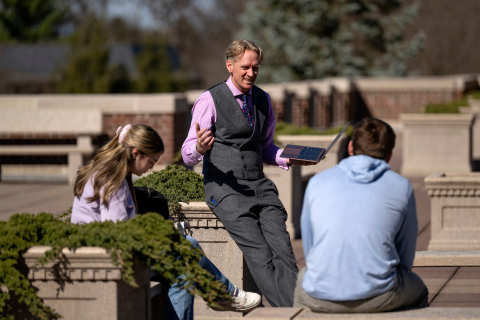
Professor James Mark Shields, comparative humanities and Asian thought, faculty director of the center. Photo by Emily Paine, Marketing & Communications
"The name change leans into ecology as an interdisciplinary endeavor — encompassing the scientific, social, creative, and humanistic threads that connect us to the natural world and to one another," says Professor James Mark Shields, comparative humanities and Asian thought, and faculty director of the center.
According to Shields, the word "ecology" traces back to the Greek oikos and means household or dwelling place. It was coined by the biologist Ernst Haeckel in 1866 to describe the relationships between living organisms and their environments.
"At its root, ecology is about belonging: how we are connected to the natural world and to each other," Shields says. "That scope — from the microscopic to the global, from the scientific to the social and humanistic — is exactly what we do."
"When you look at ecology, and you look up the definition, it's very broad — particularly as it relates to social ecology and human ecology," adds Janeen Putman, center operations director. "So there's much more to human ecology than the science of biology. For me, it makes more sense for us to call ourselves The Ecology Center."
Staying True to Its Core Programs
The center's core staff, programs, and initiatives will remain unchanged. The Ecology Center will continue operating its three primary programs:
- Watershed Sciences & Engineering (WSE), directed by Benjamin Hayes and and WSE Program Scientist Sean Reese
- Place Studies, directed by Shaunna Barnhart
- Sustainable Technology & the Built Environment, directed by Olyssa Starry
These programs are supported by Putman, Shields and Krista Smith, office assistant.
The center's mission focuses on advancing understanding of natural systems and human-nature relationships through research, teaching and engagement. Its strategic goals include supporting theoretical and applied scholarship, fostering interdisciplinary teaching and learning, encouraging innovation and creativity across the University, collaborating with community partners, and strategically directing resources to address environmental challenges.
Established in 2005 as the Bucknell Environmental Center, the initiative was launched with support from approximately 50 faculty and staff members across the University, as well as students. Early efforts focused on campus greening initiatives and the Susquehanna River, with a third emphasis on the environmental humanities added soon after.
In 2015, the center adopted the name Center for Sustainability & the Environment and launched the Coal Region Field Station, which has since become a model for community-engaged learning.
Across its programs, the center conducts long-term environmental monitoring for hypothesis-driven research with students and faculty. Some of that work addresses global issues, while others help inform public policy and community decision-making at the local and regional level.
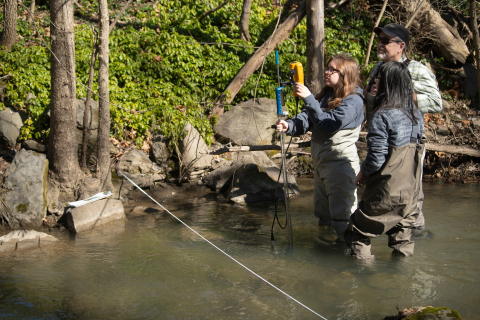
Benjamin Hayes, program director, Watershed Sciences & Engineering, directs students in his streams ecology class. Photo by Emily Paine, Marketing & Communications
"The work of our students, faculty and staff is becoming increasingly important not only to informing the academic community, but also for helping shape long-range planning and policy here in the Chesapeake region and across the world," says Hayes, who has served the center all 20 years and advises both the Pennsylvania and Maryland governors on matters related to the Susquehanna River and Chesapeake Bay. "Society faces increasingly complex, inter-related social and ecological issues, and the Center's mission is directed toward helping discover solutions and answers to key problems or data gaps."
Tackling the World's Confounding Issues
Center leaders say preparing students to address those challenges remains a core priority.
"The center is meant to be a living hub — a place where students and faculty can come together to engage with the problems that are defining our moment: food, water, climate and so on," Shields says. "These aren't abstract issues. They're the challenges of our lifetimes. And they require an interdisciplinary focus."
As the center enters its third decade, leaders say the new name emphasizes the interconnected systems — environmental, social and technological — that shape the future.
"Through our work and the efforts of the other centers on campus, Bucknell is serving as a catalyst for positive change in our region," says Hayes, who has directed one of the center's other signature events, The River Symposium, over the past 20 years. "Looking forward, we are helping people better appreciate, understand, and value the connection between the natural and human parts of their communities. That is a worthy cause and something that benefits all mankind."