Summer Researchers Cross Disciplines to Discover New Insights
August 13, 2026
With the support of the Biomedical Engineering department, Tanner Tighelaar '27, biomedical engineering, spent his summer researching how to make a new silicone anatomy model for a biology lab on campus. Photo by Emily Lamparter, Marketing & Communications
What can the art of sculpture reveal about the architecture of the human body? How does our relationship with AI impact our financial decisions? What new innovations are happening across the healthcare industry — and are consumers ready for them? This summer, Bucknellians from across the three colleges reached outside of their majors to find answers.
Art + Engineering
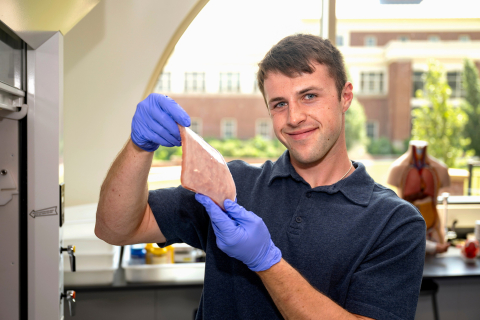
Tanner Tighelaar '27, biomedical engineering, combined his engineering background with his artistic vision to create a silicone anatomy model for one of the biology labs on campus. Photo by Emily Lamparter, Marketing & Communications.
In one of the biology labs in the Rooke Science Center, there was an old, wooden anatomy model of a skin sample. Technically, there was nothing wrong with it, but Tanner Tighelaar '27, biomedical engineering, wondered if there was an opportunity to update the wood into something more modern. "I grew up with an interest in art, so I was taking a sculpture class at the time and talking with my professors about how cool it would be if there was a model that actually felt like skin, something that showed different cells and layers," says Tighelaar. "That's really how I started working with silicone."
For Tighelaar, his artistic instincts have always been inextricably tied to his analytical mindset. When he encounters a problem, he not only wants to solve it — he wants the solution itself to be as aesthetically pleasing as possible. "I wanted to create a model that could teach students but also serve as a piece of art," he says. So, working under the guidance of Professor Theo Hopper, biomedical engineering, and Professor Jayne Kubat, biology, and with the support of the Biomedical Engineering department, he spent his summer researching how to turn his idea into a reality.
By experimenting with different additives and curing times, Tighelaar was able to create silicone models that closely simulate different layers of the epidermis and muscle and connective tissues. "I'm ultimately trying to make artificial skin grafts that can help students practice everything from surgeries to sutures," he says.
The project is a unique blend of engineering and artistry. "So much of engineering is about efficiency. You want your product to work, so my first concern with these silicone slabs is understanding the properties that will turn them into valuable learning tools," he says. However, making the models visually appealing also impacts how students interact with them. "There doesn't have to be an artistic side to it, but I'm interested in the intersection between utility and aesthetics. I don't want to make a museum display; I want to make something that people want to touch and engage with."
Artificial Intelligence + Finance
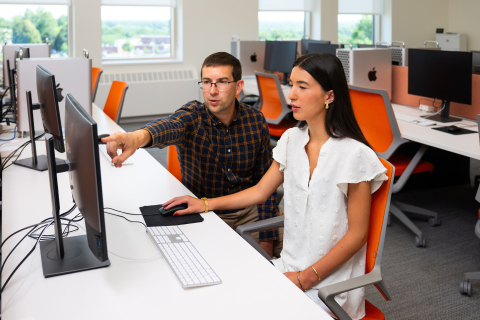
Grace Gerosa '29, economics, worked with Professor James Lawson, accounting, to determine how people are using AI for financial trading advice. Photo by James T. Giffen, Marketing & Communications
By the time Grace Gerosa '29, economics, arrived on campus, large language models like ChatGPT, Claude and Google Gemini had already entered the mainstream. While these artificial intelligence tools had grown in popularity among her peers, their ubiquity still raised questions for her. "How is it going to change the structure of education? How is AI going to impact getting a job?" asks Gerosa. "It's still such a new technology that I knew I could play a role in finding answers."
With support from the Program for Undergraduate Research, Gerosa connected with Professor James Lawson, accounting, whose own research examines how generative AI is used to make tax-related decisions. Over the course of 10 weeks, Gerosa focused on exploring how AI has shaped the disposition effect: a well-documented behavioral bias that describes investors' tendency to sell winning investments too early while holding on to losing investments too long. "Specifically, I'm interested in people who use AI for financial trading advice, and whether this same bias appears in AI systems," says Gerosa, who learned basic coding through the Dominguez Center for Data Science to conduct her research.
Gerosa, who attended the 2026 AI Symposium and the Critical Perspectives in AI Conference, hopes to demystify the emerging relationship between AI, human behavior and financial decision-making. "It's a complex issue, but Professor Lawson has been a great mentor. He really allows me to take ownership over my work," she says. "Just being able to regularly meet with him, have in-depth conversations and bounce ideas off each other has already given me a lot of skills that will benefit me in the future."
Healthcare + Entrepreneurship
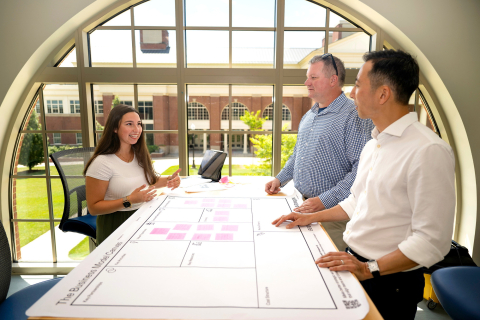
Gianna Sangillo '29, accounting, explored her interest in the business of healthcare as part of the Med(Tech) Entrepreneurship Program, which is led by Professor Charles Kim, mechanical engineering (far right), and Professor Bill Meek, management and entrepreneurship. Photo by Emily Lamparter, Marketing & Communications
At Bucknell, Gianna Sangillo '29, accounting, discovered an interest in the business of health care — and the Med(Tech) Entrepreneurship Program gave her the opportunity to delve even deeper. Led by Charles Kim, mechanical engineering, and Bill Meek, management and entrepreneurship, the summer program allows students to research innovative business strategies for biomedical technologies.
In Sangillo's case, she conducted market research for an NDA-protected healthcare management technology that was started by Sean O'Connor '26. "Our team completed between 30 and 40 customer discovery interviews with patients, doctors, CMOs (Chief Medical Officers), nurses and caregivers across primary care clinics and hospitals. By gathering stakeholder insights, we identified unmet market needs, refined the product's value proposition, developed a prototype and created a final pitch deck outlining our commercialization strategy," says Sangillo, who traveled to Philadelphia on June 19 to present the team's research to healthcare leaders and private equity executives.
Sangillo credits her preparation for the Med(Tech) program to her experience in the Design Thinking Leadership Pre-Orientation program, where she conducted market research for Elizabeth Malley '26, biomedical engineering, who won first prize at the 2025 BizPitch competition for ThermaIV, a self-heating, power-free IV bag designed to prevent hypothermia. "That experience gave me an early understanding of how market validation and customer feedback drive innovation in healthcare. Working at the intersection of business strategy, entrepreneurship and medical technology showed me how patient-centered solutions can become commercially viable products," she says. "It ultimately inspired me to pursue a minor in entrepreneurship because I want to help bring innovative healthcare technologies and systems to market, improve patient outcomes and create value across the healthcare ecosystem."