Bucknellians Head Abroad on Fulbright Fellowships
July 7, 2026
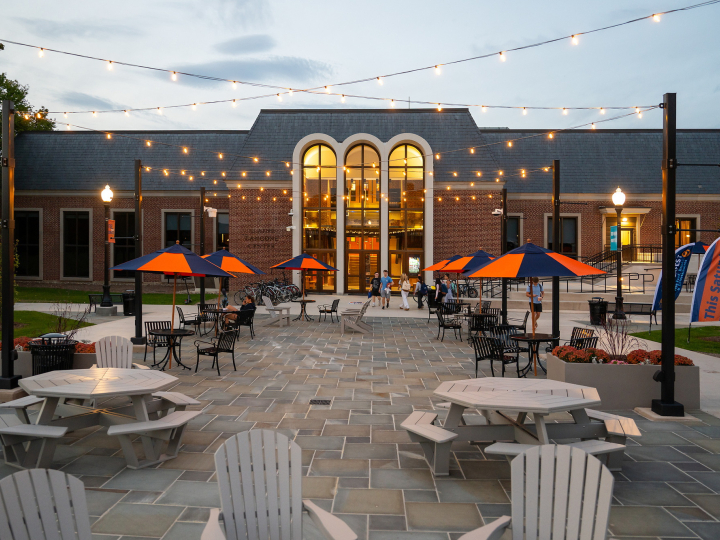
MacDonald Commons, home to the Bucknell “B” statue. Photo by Emily Lamparter, Marketing & Communications
Six Bucknellians have been awarded Fulbright fellowships, one of the world's most prestigious academic honors. Established by the U.S. Department of State, the Fulbright Program supports study, research and teaching opportunities in more than 140 countries with the goal of strengthening cross-cultural understanding and academic collaboration. Recipients are selected through a competitive process that recognizes exceptional achievement, leadership and global engagement. Three recent graduates have earned Fulbright U.S. Student Program grants, and three faculty members have been named Fulbright U.S. Scholars.
Susan Deering '26
Susan Deering '26, a cell biology and biochemistry major with a minor in computer science, will pursue a Fulbright Postgraduate Research Scholarship at the Australian National University. Her research will examine the genetic causes of kidney disease in the Indigenous Australians of the Tiwi Islands, a population with the highest rate of kidney disease in the world. Deering says she hopes her findings will benefit the Tiwi community while advancing scientists' understanding of how the immune system contributes to kidney disease and other illnesses.
As a Presidential Fellow, Deering conducted research in Professor Sarah Lower's biology lab, studying the genomic processes underlying the evolution of communication in fireflies. Through this work, she has developed strong skills in bioinformatics and experimental biology.

I am excited for the opportunity to gain further research experience before graduate school and also to learn how to do community engaged research.
Susan Deering '26; photo by James T. Giffen, Marketing & Communications
Her research experience also includes participation in the MIT Summer Research Program, where she worked at the Koch Institute for Integrative Cancer Research. There, she gained hands-on experience in immunology research that will inform her Fulbright research in Australia.
Deering further expanded her global research training through a study abroad in Belgium, where she worked in the laboratory of Joris Vermeesch at KU Leuven through the ISA EuroScholars program. There, she strengthened her bioinformatics expertise while contributing to a human medical genomics project.
Deering, who is from Landenberg, Pa., credits Bucknell mentorship for shaping her academic path, especially Professor Lower. She also notes that her work with Margaret Marr, former director of the Program for Undergraduate Research, on her Fulbright application was especially formative in strengthening her scientific communication and writing.
Brooke Corpuz '26
Brooke Corpuz '26, an English — creative writing and East Asian studies double-major, minor in economics, will spend the next year in Thailand as a Fulbright English Teaching Assistant. Her experiences with Bucknell in Ghana and a study abroad program in Kyoto shaped her commitment to immersive, cross-cultural learning and strengthened her ability to navigate language and culture.

Studying abroad through the Bucknell in Ghana program taught me the value of learning through immersion; studying abroad in Kyoto enabled me to demonstrate my capacity to learn languages.
Brooke Corpez '26; photo by Soujy
A writer with Thai heritage, Corpuz plans to pursue an MFA in prose and ultimately become a creative writing professor. Her work often explores the intersections of memory and identity, particularly as she seeks to better understand a cultural lineage shaped by her mother's adoption. Her essay, "Hard to Place," reflects on the absence of biological family connections and the resulting search for belonging within Thai heritage. She is also writing a fantasy novel inspired by Thai folklore and expanding "Hard to Place" into a memoir.
"To write the stories I've always wanted to tell, I must live in Thailand," says the Frederick, Md., native.
At Bucknell, she credits the creative writing community, the Stadler Center for Poetry & Literary Arts, and Stadler Fellow Jessica Nirvana Ram, for helping her envision a sustainable writing life, and expresses special gratitude to her honors thesis advisor, Professor Joe Scapellato, English, for his guidance on her novel. She is grateful for support from Margaret Marr, former director of the Program for Undergraduate Research; Professor Robert Rosenberg, English; Professor David Del Testa, history; Margaret "Peg" Cronin, writing & teaching consultant; Deirdre O'Connor, writing & teaching consultant; and Professor John Hunter, comparative & digital humanities.
Haley Beardsley M'26
Haley Beardsley M'26, who received her master's in English, has been awarded a Fulbright English Teaching Assistantship in Germany. Although honored to receive this fellowship, Beardsley has chosen to pursue a U.S. Teaching Assistantship through the Austrian-American Educational Commission, an Austrian government-funded program that places Americans in Austrian secondary schools to teach English. (Participants are salaried employees of Austrian school districts rather than Fulbright grantees.)

In my application, I was able to convey my commitment to lifelong learning through international exploration, demonstrating my curiosity, adaptability and persistence.
Haley Beardsley M'26; photo courtesy of Haley Beardsley M'26
Beardsley attributes her strength as a candidate to a combination of extensive teaching experience and global engagement. While completing her master’s degree at Bucknell, she has also pursued a post-baccalaureate education certification through Commonwealth University. This spring, she student taught, gaining direct, day-to-day classroom experience that has confirmed her commitment to education.
Her global perspective has been shaped by international travel. At Bucknell, she completed two summer abroad experiences, including the Bucknell on the Camino de Santiago program and the Advanced Studies in England program. The Pittsburgh native has also traveled to Austria, Germany, New Zealand and France.
These experiences, she notes, reflect a commitment to holistic, lifelong learning and have strengthened her adaptability, curiosity and persistence as an educator. She describes the application process as the highlight of her fall 2025 semester, noting that it helped her clarify her core professional motivations. "It is truly challenging to identify your core motivation for your profession," she says. "This experience has connected me with my 'why,' which will guide me for years to come."
Beardsley says she is grateful for the support of Professor Bastian Heinsohn, German studies; Professor Janet VanLone, education; Professor Ted Hamilton, education; Professor Chase Gregory, English; and Diane Jakacki, digital scholarship coordinator. She credits Margaret Marr, former director of the Program for Undergraduate Research, with especially formative mentorship, noting that she read every draft of her application, provided detailed feedback and helped her clarify her personal and professional motivations.
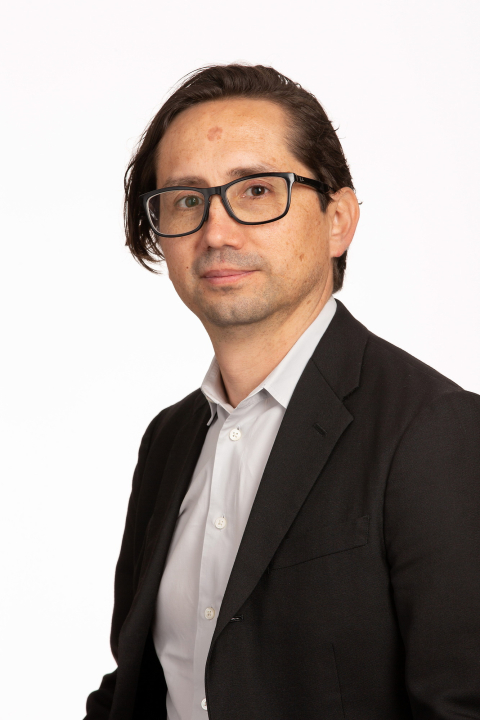
Professor David Rojas, Latin American studies, examines the social and economic forces reshaping the Amazon rainforest. Photo by Douglas Kilpatrick
Professor David Rojas, Latin American studies
In the Brazilian Amazon, where global demand for food meets the realities of daily survival, Professor David Rojas, Latin American studies, examines how people make a living from the land.
Rojas has been awarded a Fulbright U.S. Scholar Program award to continue his long-term research in Brazil, where he studies the social and economic forces reshaping the Amazon rainforest. He will spend two months living in Amazonia, where he has conducted field research for nearly two decades.
I study how specific locations are connected to global trends and how the actions of people on the ground reverberate at a planetary scale.
His work focuses on non-indigenous family farmers who have migrated into the rainforest in search of economic opportunity. They often transform forested land into pasture and agricultural production.
"These are some of the poorest populations in Brazil," he says. "For them to earn a living very often means to cut the forest and replace it with pastures, and that has all sorts of implications for society, for the economy, for the climate."
Rather than studying these changes from a distance, Rojas grounds his research in immersive fieldwork. As an anthropologist, he lives and works alongside the communities he studies, participating in daily labor, including farming, fishing and hunting. This approach, he says, offers a deeper understanding of how global systems of trade and development are experienced and built from the ground up.
His research helps illuminate how regions like the Amazon are embedded in global economic systems. Brazil, for example, is the world's largest exporter of animal protein and grains, much of which is produced in areas undergoing rapid deforestation and agricultural expansion.
At Bucknell, Rojas' research directly informs his teaching. His popular course Rainforest and Eco Politics examines rainforest regions through the lens of lived experience and global environmental change. He is also developing additional courses that explore how local actions connect to planetary-scale environmental and economic systems.
Beyond the classroom, he works with students on research projects that examine economic conditions in the surrounding region and explore how academic work can contribute to local communities.
Professor Elizabeth Mamros, mechanical engineering

Professor Elizabeth Mamros, mechanical engineering focuses on sheet-metal forming techniques used to create complex, high-precision components. Photo by Douglas Kilpatrick
Five years after her first Fulbright took her to Germany as a graduate student, Professor Elizabeth Mamros, mechanical engineering, is returning as a U.S. Fulbright Scholar. During a 12-month appointment as a visiting scholar at Technische Universität Chemnitz, she will advance her research in advanced manufacturing while expanding international research collaborations.
I hope to bring back new techniques, new materials and new ways of teaching that I can share with my students.
The award marks a full-circle moment for Mamros. She first received a Fulbright as a graduate student at the University of New Hampshire. With that award, she traveled to Dortmund, Germany, where she conducted research on sheet metal forming processes. Now, as a faculty member, she is returning to the country to continue that research.
Her work focuses on sheet-metal forming techniques used to create complex, high-precision components ranging from automotive panels and aerospace parts to patient-specific cranial implants. A key part of her research is incremental forming, a process in which a computer-controlled tool slowly shapes metal into custom forms without the need for traditional models or stamping dies. This enables the production of small batches of highly customized parts, which is especially useful for medical implants that often need to be tailored to individual patients.
Beyond research outcomes, Mamros sees the opportunity as a two-way bridge. She plans to bring insights directly back to Bucknell classrooms and labs while also deepening connections with industry partners in the automotive and aerospace sectors to help translate research into practical applications. In addition, she hopes to explore student exchange and learning opportunities between Germany and Bucknell.
Professor Josie Torres Barth, English — film/media studies
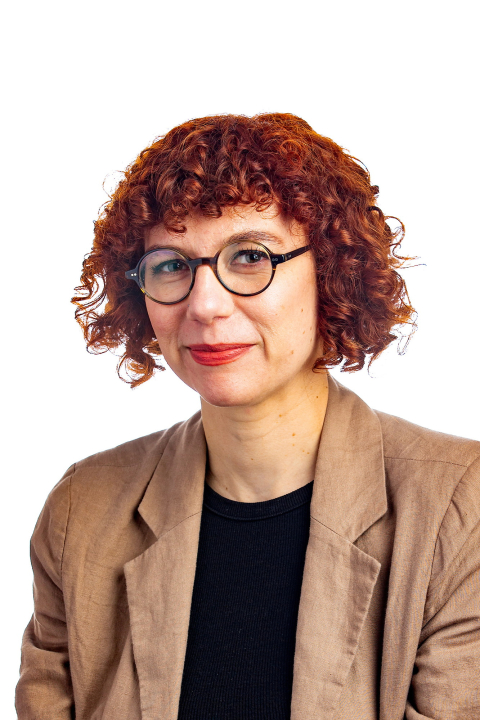
Professor Josie Torres Barth, English — film/media studies, examines how horror programming on radio and television reflected Americans’ anxieties following World War II. Photo by Douglas Kilpatrick
When Professor Josie Torres Barth, English — film/media studies, first studied the history of radio and television as a graduate student, she became fascinated by how unsettling these now-familiar technologies once seemed. That curiosity became the foundation of her research, which examines how Americans experienced those new forms of media during a period of dramatic social change through stories of the supernatural and unknown.
As a Fulbright U.S. Scholar Award recipient, Barth will spend nine months at the University of Sheffield in England to further develop a book titled Uncanny on Air: Horror Anthologies from Radio to TV in the Postwar Home. The project examines how horror programming on radio and television reflected Americans' anxieties about family life, gender roles, and rapid social and technological change during the decades following World War II.
The Fulbright will give me the opportunity to immerse myself in a community of scholars who are asking many of the same questions from different perspectives, while also allowing me to share an American perspective on the Gothic.
At Sheffield, Barth will collaborate with scholars affiliated with the Centre for the History of the Gothic and a film and television research center. The residency will provide her with dedicated time to complete research while also creating opportunities to share her scholarship.
Central to Barth's research is the idea of the "uncanny" — the unsettling feeling that something familiar has become strange. She explores how horror programming reflected broader social anxieties in postwar America, including changing expectations for women.
"One of the things I've found in my research is that a lot of these big changes are recognized and seen through metaphors of the supernatural or metaphors of the uncanny," she says. "I find it very interesting that this is before a moment when questions about women's roles in society were widely discussed in media and popular culture."
The Fulbright experience will also enrich Barth's teaching at Bucknell. By studying Britain's public service broadcasting model and engaging with scholars in the United Kingdom, she hopes to bring new international perspectives on media history and broadcasting back to her students.