Undergraduate Research at Bucknell Leads to Four Goldwater Scholarships
May 6, 2026
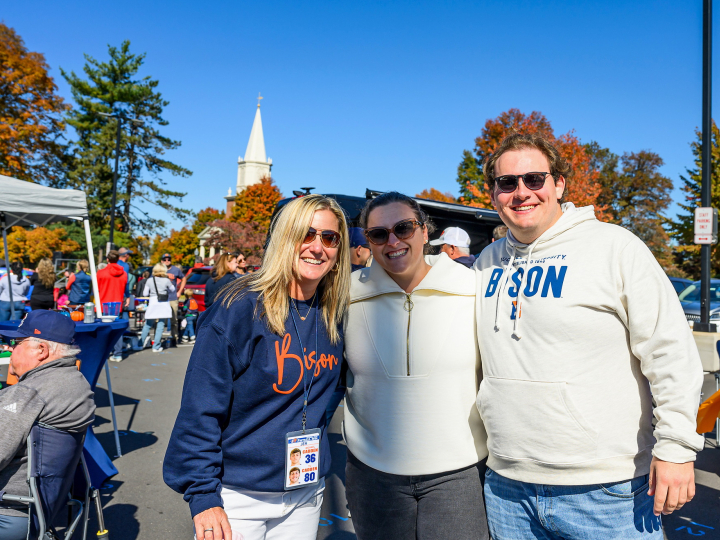
Angel Eunisse Yanga '28 works alongside Professor Ken Field, biology, to study bat immunology and infectious disease. Photo by Emily Paine, Marketing & Communications
Each year, Bucknell students compete for some of the nation's most prestigious and competitive scholarships — awards that reflect academic excellence, intellectual curiosity, persistence and a sustained commitment to their goals.
This spring, Bucknell nominated four students for the Barry Goldwater Scholarship — and all four were selected, a rare four-for-four outcome that underscores the strength of the students and the mentorship behind them.
Much of that guidance came from Margaret Marr, who retired in March after serving as Bucknell's director of the Program for Undergraduate Research for 10 years. Over her tenure, Marr guided students through competitive application processes, helping them clarify their goals, refine their narratives and strengthen their materials.
Her impact extends beyond individual students. In 2026, Bucknell was named a top producer of Gilman Scholars, and in 2024, a top producer of Fulbright Scholars — national recognitions that underscore the University's growing strength in high-impact fellowship preparation.
"Margaret Marr was instrumental in helping me prepare my application materials," says Goldwater recipient Angelina Santos '27, biomedical engineering. "She asked me what felt like never-ending 'why' questions. With her encouragement and the immense effort she put into getting to know me, she pushed me to more deeply explore my passions and better understand my motivations for pursuing a research career."
"It has been an absolute joy and honor to work with Bucknell's many scholarship applicants, helping them to learn how to mold their exceptional accomplishments and noble goals into persuasive applications," Marr says. "In exchange, I have learned a great deal from them — about the world, about science, about how our experiences shape our goals and values."
Starlette Marie Sharp has joined Bucknell as the new program director of Undergraduate Fellowships & Research, continuing Marr's mission of guiding and supporting Bucknell scholars.
Barry Goldwater Scholarship
The Barry Goldwater Scholarship & Excellence in Education Foundation recognizes students who demonstrate the curiosity, discipline and vision to become the next generation of research scientists. From a pool of more than 5,000 college sophomores and juniors, 1,485 students in science, engineering and mathematics were nominated by 482 institutions to compete. Widely considered the preeminent undergraduate award in these fields, the scholarship was established to identify, encourage and support students pursuing research careers in science, engineering and mathematics.
Noah Kerzner '27, physics
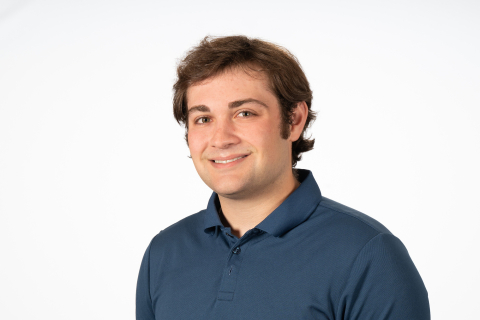
Goldwater recipient Noah Kernzer '27 is interested in pursuing further studies in quantum information science. Photo by James T. Giffen, Marketing & Communications
At Bucknell, Kerzner channeled his lifelong fascination with space into hands-on research, beginning in his first year on campus as part of Bucknell's Presidential Fellows program (now the Merit Scholars Program). He quickly built a strong foundation in quantum information science. His interest deepened during a summer Research Experience for Undergraduates at the University of Miami, where he worked in quantum computing.
"I knew that it was the field for me," he says. It was a turning point that solidified his academic focus and long-term goals. Kerzner's journey to winning the Goldwater was not without setbacks. After applying in 2025 and not being selected, he reapplied and approached the process with greater clarity and stronger materials. "Applying last year gave me experience in how to properly write essays, and that led to a stronger application this year. The award is a personal validation that people care about my research, and it matters," says Kerzner, who plans to pursue graduate study in the field.
Kerzner is grateful for the support he received at Bucknell during the application process.
"There are numerous people at Bucknell who supported me," he says. "Professor Ben Vollmayr-Lee [physics & astronomy] has been my research mentor for my entire time at Bucknell. I would never have found my passion for research without his guidance. Margaret Marr helped me prepare my materials for the Goldwater application. I probably wouldn't have finished the application if not for her. Professor Wendy Wright [mechanical & chemical engineering] provided honest feedback on my essays and helped me create my best output. Professor Ibrahim Sulai [physics & astronomy] gave me excellent technical feedback about my career and research essays, which boosted their scientific accuracy.”
Quinn Smith '27, neuroscience
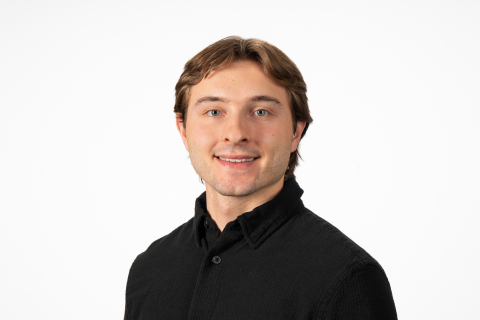
Goldwater recipient Quinn Smith '27 has conducted research in biochemistry and biomedical engineering labs. Photo by James T. Giffen
For Smith, Bucknell has been a place not only to participate in research but to develop as a scientist. Over the past three years, he has worked across both biochemistry and biomedical engineering labs as part of Bucknell's Presidential Fellows program (now the Merit Scholars Program), gaining experience in two distinct research environments while steadily taking on greater ownership of his own work.
"I have been able to guide my own research, asking questions, designing experiments, and conducting data analysis," says Smith, who is from Hanover, Pa.
That hands-on experience has helped shape his long-term career goal: to become an M.D./Ph.D. focused on Alzheimer's disease. His interest in the field is personal. As an EMT and hospice volunteer, he has worked with patients and families affected by dementia, which has motivated him to make an impact.
"I would often come away frustrated by the lack of power families or medical providers had as the dementia progressed," he says. A research conference later introduced him to cutting-edge work in Alzheimer's treatment and reversal, which shifted his frustration into direction.
Smith says the Goldwater Scholarship is both a meaningful recognition and motivation. "This scholarship symbolizes my commitment to research and is a gateway into many of the programs I am interested in."
He also says he hopes his experience encourages other students to pursue competitive scholarships of their own.
Smith credits the mentors who helped shape his research and his application. "Margaret Marr was unparalleled in making me think deeply about what I have done so far and why I want to pursue Alzheimer's disease research. I couldn't have written a quality application without her guidance," he says. "I would also like to thank my research advisor, Professor Karlo Malaga [biomedical engineering]. Not only has Dr. Malaga helped me develop as a researcher, but he has also helped me through many iterations of my research essay. In addition, I would like to thank Professor Sarah Smith [chemistry] and Professor David Evans [psychology], who helped me with multiple drafts of essays and were kind enough to write letters of recommendation for me."
Angelina Santos '27, biomedical engineering
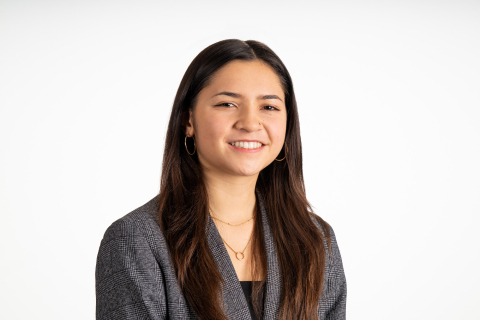
Goldwater recipient Angelina Santos '27 has conducted biomedical engineering research at Bucknell. Photo by James T. Giffen, Marketing & Communications
For Santos, the Goldwater Scholarship reflects a research journey shaped by a range of hands-on experiences across biomedical engineering and translational science. Her work has spanned institutions including Bucknell, the University of Pennsylvania and the Karolinska Institutet in Sweden, where she has explored how engineering approaches can be applied to complex biological and medical challenges.
Coming to Bucknell from San Jose, Calif., pushed her outside her comfort zone, but she found support in student organizations, including Bucknell's Presidential Fellows program (now the Merit Scholars Program), which helped her feel grounded. Within those spaces, she developed not only as a researcher but also as a mentor, taking on leadership roles and supporting peers in the same communities that helped her find her footing.
Influenced early by relatives and family friends in nursing and social work, Santos was drawn to health care but found her path through robotics and practical lab experience working with Professor Olivia Boerman, biomedical engineering.
For a time, Santos was uncertain whether to pursue graduate school or enter the medical device design industry. The Goldwater recognition, however, has helped clarify that path, making the prospect of graduate study feel more attainable, she says.
This summer, she will continue building on her research experience in an immuno-engineering lab at Johns Hopkins University, where she will study how engineered systems can be used to better understand and influence immune responses. Santos has relied on a strong network of mentors.
"Professor Olivia Boerman was particularly supportive — she and many of my biomedical engineering professors read over my essays and were the first people to congratulate me," she says. "The entire department was so enthusiastic about celebrating my achievement with me that it made winning the award feel much more special and made me feel more deserving of it. In addition, Jason Milner, director of the Engineering Success Alliance, provided me with moral support throughout the entire process."
Angel Eunisse Yanga '28, biology
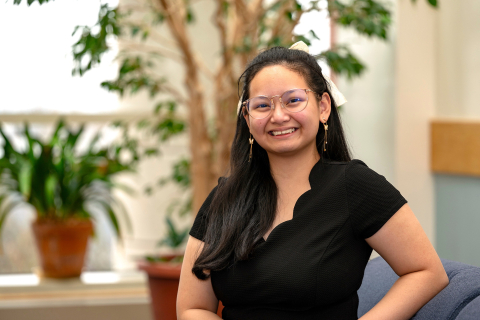
Angel Eunisse Yanga '28 has been named a Goldwater Scholar, an honor that reflects her undergraduate research in biology. She also received a Ubben Award, a highly selective scholarship that grants five Posse Scholars nationwide a $10,000 stipend and a summer internship. Photo by Emily Paine, Marketing & Communications
A year into her Bucknell experience, Yanga was already conducting fieldwork in Uganda as part of an international research team studying bat immunology and infectious disease transmission. The work was as immersive as it was unpredictable.
"I've been caught in a storm on the Nile River, trekked through marshland to spot shoebills and stood several feet from a teenage rhino," says Yanga, who grew up in the Philippines and immigrated to Los Angeles before starting high school.
Collaborating with Bucknell professors Ken Field and DeeAnn Reeder, biology, Yanga supported biological data collection while drawing on her engineering background. Building on her high school robotics experience, she designed a low-cost automated bat-tracking system that she first developed in Lewisburg and later deployed in Uganda.
"I was initially unsure that I belonged in an immunology lab," she says. "But I saw that there is more than one way to contribute to biology research." That realization strengthened both her commitment to research and her confidence in her place within it.
Yanga also points to the mentors and collaborators who helped her find her place in research.
"Professors Ken Field and DeeAnn Reeder have been the best support system I could have ever asked for across different parts of my Bucknell experience — from the lab, to the field, to my journey as a first-generation student with big dreams," Yanga says. "Ken, in particular, is an incredible mentor and a constant source of energy; his positivity and encouragement push me to keep going even when things feel overwhelming.
She also credits a wider network of support at Bucknell, including her Posse Scholars Program mentor, Professor Elisabeth Guerrero, Spanish; Sarah Bell, director of career readiness and education at the Center for Career Advancement; Stacey Piecuch, assistant director of Community Engaged Leadership, Learning & Research; and her academic adviser, Professor Emily Stowe, biology, who all helped her develop and refine her essays.